Plastic welding equipment for geomembrane, liner and tarpaulin work. Shipped from Dubai worldwide.+971 50 855 3875info@geomembraneweldingmachine.com
Geomembrane Welding MachineWelding machines · +971 50 855 3875

Geomembrane welding machine supplier in Dubai

Hot wedge welders, hand extrusion welders, hot air guns and seam testing kit for HDPE liner installation. Held in stock in Dubai, shipped to lining contractors across the Gulf, Africa and Asia.

Automatic hot wedge welding machine running a dual track seam along overlapping black HDPE geomembrane sheets
An automatic hot wedge welder producing a dual track seam with a central air test channel.
  • Materials welded
    HDPE, LLDPE, PVC, PP
  • Liner thickness welded
    0.2 to 3.0 mm
  • Supplied from
    Dubai, UAE
  • Export markets
    Gulf, Africa, Asia

Equipment for every seam on a lining project

A geomembrane liner is only as good as its joints. The sheet itself is tested and certified before it ever reaches site, but the seams are made in the field, in heat, dust and wind, by a crew working to a fixed programme. That is where projects are won or lost, and it is the reason we supply welding plant rather than liner alone.

We supply and service the full set of thermoplastic welding equipment used on geomembrane installations: automatic hot wedge welders for production seams, hand extrusion welders for patches and detail, hot air welders for tacking and thin material, extrusion welding rod, and the air pressure and vacuum testing kit that proves the work. We are a supplier and dealer, not a manufacturer, which means we can put the right machine in front of you rather than the only one we make.

Machines are stocked in Dubai and dispatched worldwide. Contractors in the UAE can collect the same day. For projects abroad we handle the export paperwork, match the machine voltage to the destination, and can consolidate equipment with a geomembrane sheet order in one shipment.

The machine range

Three welding processes cover every seam type on a liner installation, plus the consumables and test equipment that go with them.

  • IZ-900 hot wedge welding machine sitting on black HDPE geomembrane liner, ready to run a seam

    IZ-900 wedge welding machine

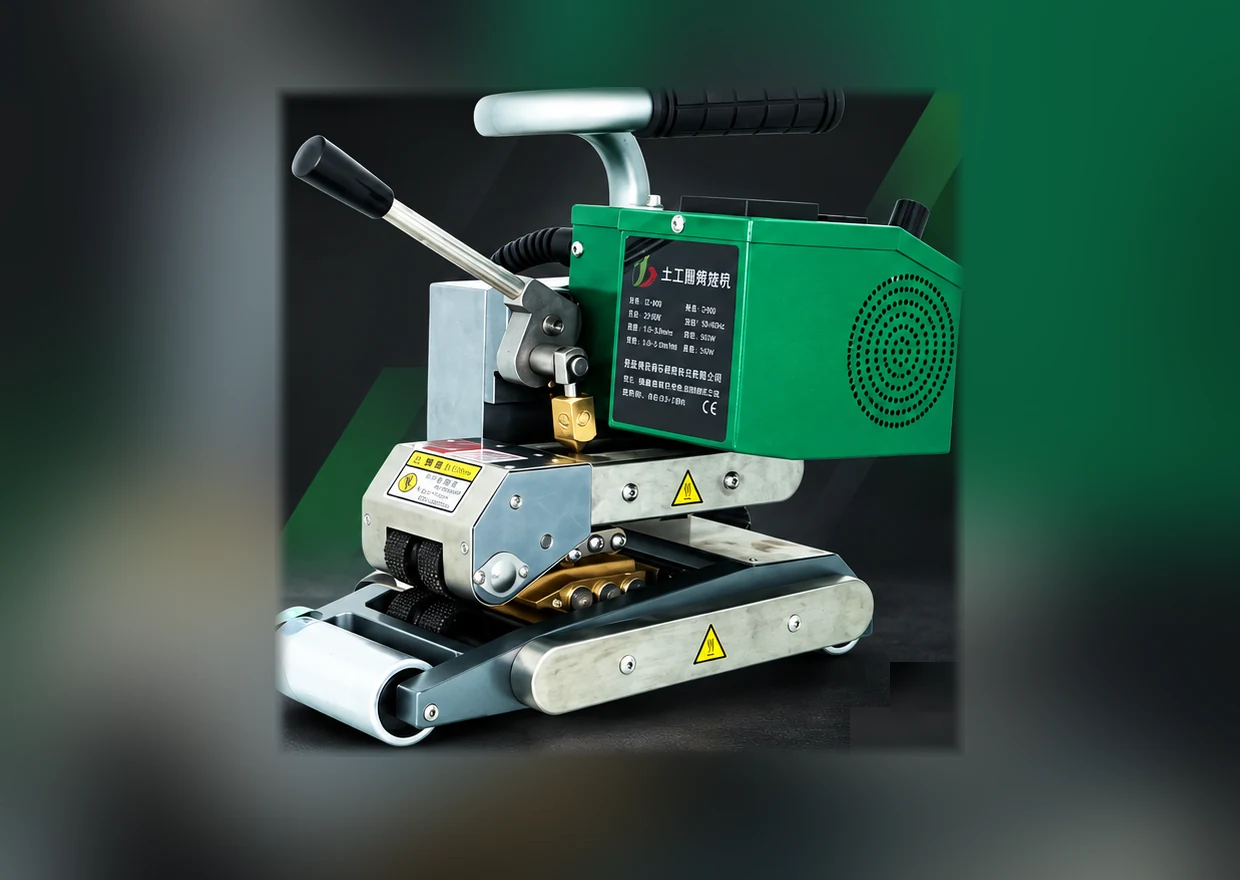
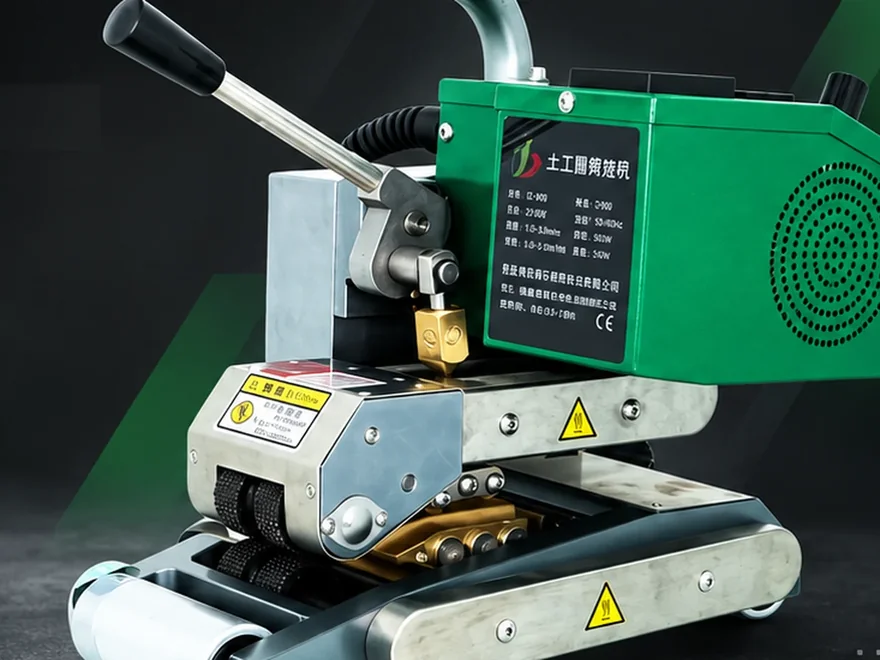
    The IZ-900 automatic hot wedge welder produces the long production seams. Self-propelled, with dual digital control of temperature and speed, and a dual track weld that leaves a sealed channel for air pressure testing.

    • ModelIZ-900
    • Typical speed1 to 7 m/min
    • Liner range1.0 to 3.0 mm
    Wedge welder specifications
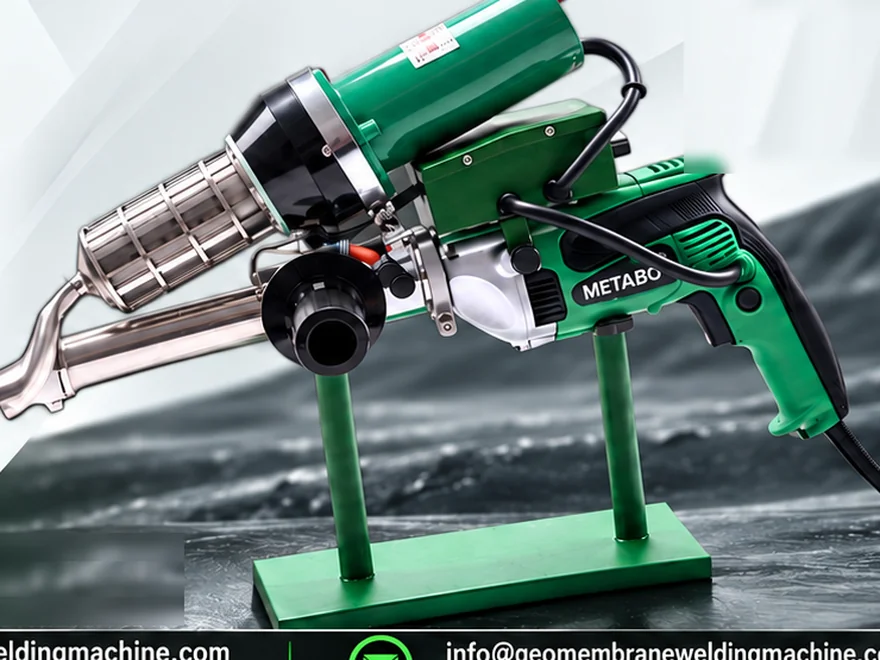
  • Hand held HDPE extrusion welding machine with welding rod feed laying a fillet bead along a liner patch

    IZ-620 extrusion welding machine

    The hand extrusion welder used for patches, repairs, pipe penetrations and every corner a wedge welder cannot reach. Feeds 3 mm or 4 mm HDPE rod and lays a fillet bead over the sheet edge.

    • Seam typeFillet bead
    • Rod diameter3.0 to 4.5 mm
    • Output1.8 to 3.6 kg/h
    Extrusion welder specifications
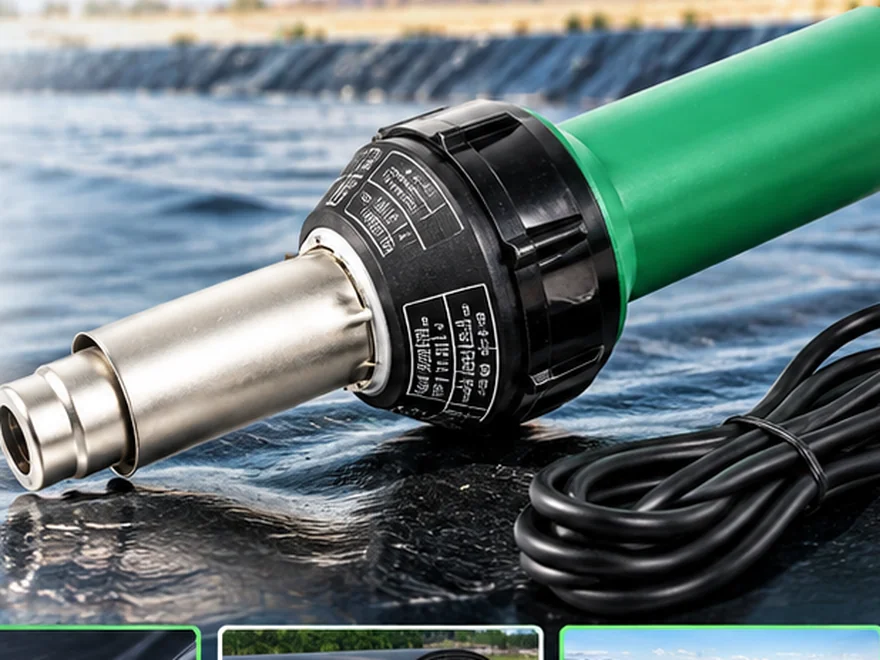
  • Hot air welding gun with a flat nozzle tacking two sheets of geomembrane together before the main weld

    IZ-1600 hot air gun

    The IZ-1600. For tacking liner in position, welding PVC and tarpaulin, and preheating before extrusion work. 1600 W, 180 L/min, 1.05 kg. The cheapest and most used item on a lining crew's plant list.

    • Air temperature20 to 620°C
    • Power1,600 W
    • Weight1.05 kg
    Hot air welder specifications
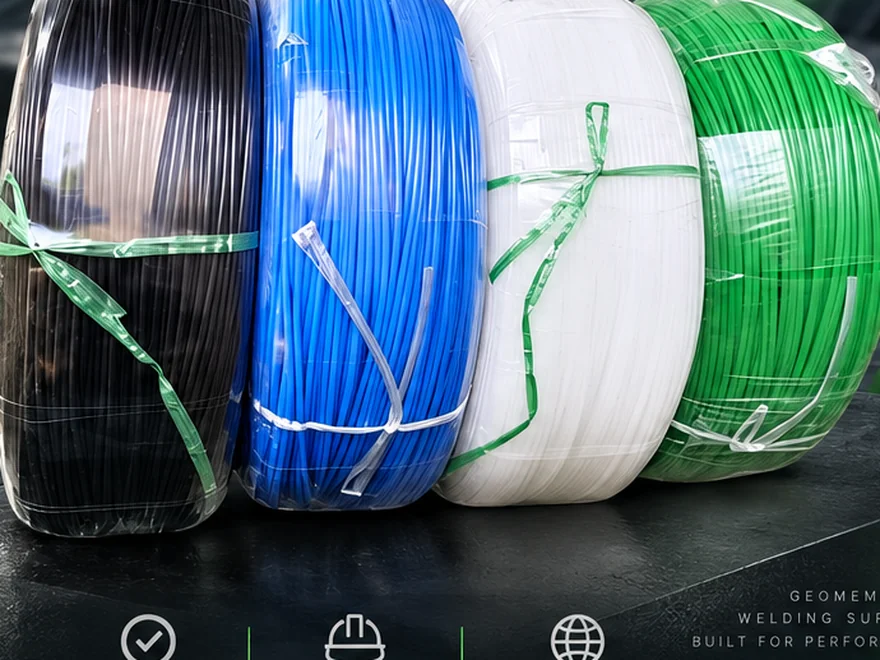
  • Wrapped coils of 4 mm plastic welding rod in black, blue, white and green for geomembrane welding

    Welding rod and filler

    4 mm HDPE welding rod in black, blue, white and green, plus LDPE, PP and PVC. Using rod of the wrong grade, or the wrong colour on an exposed liner, is a common reason a repair fails.

    • Headline size4 mm
    • ColoursBlack, blue, white, green
    • ResinsHDPE, LDPE, PP, PVC
    Welding rod grades
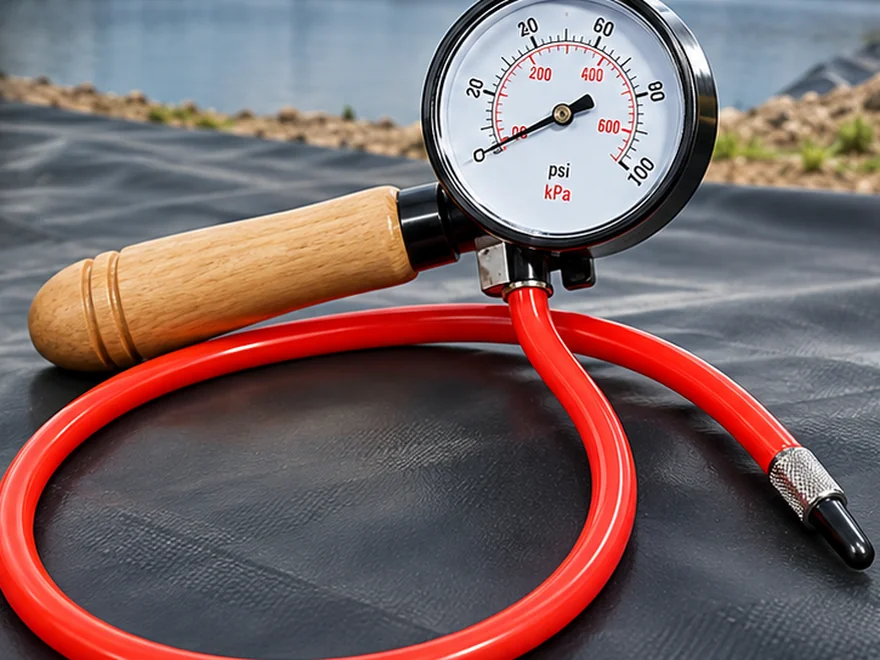
  • Geomembrane air pressure test kit with dual scale gauge, red hose and insertion needle resting on black HDPE liner

    Seam testing equipment

    Air pressure test kit with a dual scale psi and kPa gauge, hose and insertion needle for dual track seams. Vacuum boxes, spark testers and tensiometers to order. The kit that turns a finished weld into a documented one.

    • Gauge0-100 psi / 0-700 kPa
    • Air testASTM D5820
    • Vacuum testASTM D5641
    Testing equipment range
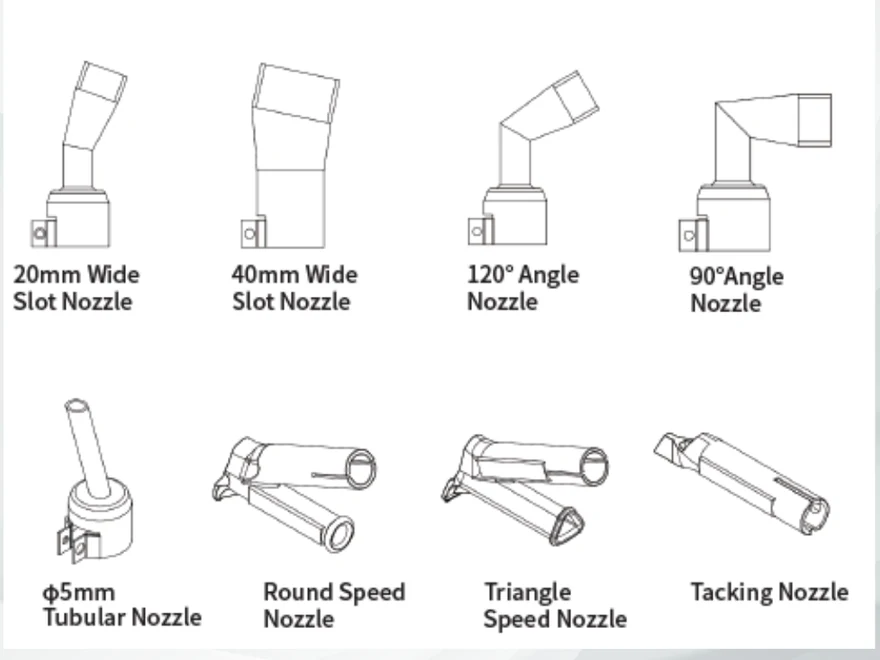
  • The eight IZ-1600 welding nozzles laid out: wide slot, angle, tubular, speed and tacking nozzles

    Spare parts and accessories

    Heating elements, carbon brushes, welding boots, nozzles, fuses and drive parts for the IZ-900, IZ-620 and IZ-1600. Held in Dubai so a worn part does not stand a crew down for weeks.

    • CoversIZ-900, IZ-620, IZ-1600
    • Brush lifeAbout 1,600 hours
    • DispatchSame day, UAE
    Parts and consumables

Weldy machines, alongside our own

We also supply four machines from Weldy, the Leister group value line. The WGW 300 welds HDPE from 0.8 mm, which the IZ-900 cannot, so it is the wedge welder for farm pond and aquaculture liner. The booster EX3 is the extruder Weldy built for geomembrane. The booster EX2 is its compact stablemate, and the HT1600 is a 700 degree hot air gun with a ceramic element.

Buyers on brand-specified projects choose Weldy. Buyers on price choose the IZ range. Both ship from the same warehouse, and mixed orders are normal. Compare the two ranges.

The Weldy range at a glance
MachineSummary
Weldy WGW 300Wedge welder, 0.8 to 2.5 mm HDPE, 0 to 8.5 m/min, 15 kg
Weldy booster EX3Extruder, 3.4 kg/h, rated for geomembrane, 6.9 kg
Weldy booster EX2Extruder, 2.5 kg/h, tanks and fabrication, 6.4 kg
Weldy HT1600Hot air gun, 40 to 700°C, 240 L/min, 1.0 kg

Where these machines are used

The same three processes appear on every containment project, at different scales.

Landfill lining and capping

Base liners and capping systems carry the tightest seam specifications of any application, with destructive peel and shear testing at set intervals along every run. A dual track wedge weld with a continuous air test record is normally mandatory, and extrusion work is limited to patches and penetrations that are individually vacuum tested.

Water reservoirs and farm ponds

Agricultural and municipal water storage in the Gulf is almost entirely HDPE lined because of evaporation loss and ground salinity. Panels are welded in place with a wedge machine and the anchor trench detail, inlet pipes and any ladder penetrations are finished with a hand extrusion welder.

Canal and channel lining

Long, narrow geometry favours the wedge welder: seams run parallel to the channel and the machine tracks continuously for hundreds of metres. Extrusion work concentrates at the transitions, structures and repairs where the liner meets concrete.

Mining, leach pads and tailings

Leach pads combine thick liner, aggressive chemistry and heavy loading, so 2.0 mm and 2.5 mm sheet is common and welding parameters have to be reset for the gauge. Both processes are used under a full construction quality assurance regime.

Tank farms and secondary containment

Bund lining involves short seams, many corners and dense pipework, which shifts the balance towards extrusion and hot air work. A small wedge welder still handles the floor panels, but detail dominates the programme.

Tarpaulin, membrane and roofing

PVC coated fabric, banner material and single ply roofing all weld with hot air rather than a wedge, at lower temperature and with different nozzles. The same hot air gun that tacks a geomembrane will do this work with a nozzle change.

Buying a welding machine from Dubai

Most geomembrane welding equipment is built in Europe or in China, and most buyers in this region are quoted ex works from one or the other. That price looks attractive until freight, duty, a voltage mismatch and a six week lead time land on top of it. Buying from a Dubai stockist removes those variables.

We hold machines locally, quote a delivered figure rather than an ex works one, supply units configured for the voltage and plug type of your destination, and keep wear parts on the shelf so a heating element or a drive roller does not stop a crew for a fortnight. For contractors in the Emirates that means same day collection from Dubai. For buyers in Africa and South Asia it means one supplier handling the machine, the consumables and the export documentation together.

More about how we work and who we supply.

Supply terms at a glance
ItemDetail
Stock locationDubai, United Arab Emirates
Supply basisSupplier and dealer, multi-brand
Voltage options220-240V and 110-120V, destination specific
FreightAir freight or sea freight, DAP or CIF
Export documentsCommercial invoice, packing list, certificate of origin
ConsolidationMachines shippable with geomembrane sheet orders
Wear partsHeating elements, rollers, nozzles, PTFE held in stock
LanguagesEnglish and Arabic

Frequently asked questions

The questions buyers ask most often before placing an order for welding plant.

What is a geomembrane welding machine?

A geomembrane welding machine joins overlapping sheets of thermoplastic liner into a continuous, watertight seam. The most common type is an automatic hot wedge welder: a heated metal wedge melts the facing surfaces of the overlap from the inside while two drive rollers press the molten layers together, and the machine self-propels along the seam at a set speed. Hand extrusion welders and hot air guns handle the detail work that a wedge welder cannot reach, such as patches, pipe penetrations and corners. All three work on HDPE, LLDPE, PVC and similar thermoplastics, and none of them use filler rod the way metal arc welding does.

What is a geomembrane used for?

A geomembrane is an impermeable plastic sheet used as a barrier to stop liquid or gas moving through soil. Typical uses are landfill base and capping systems, water reservoirs and farm ponds, canal and channel lining, mine leach pads and tailings dams, effluent lagoons, tank and secondary containment bunds, and decorative lakes. Because the sheet only performs as well as its joints, every one of those applications depends on welded seams rather than glued or mechanically fastened ones, which is why a welding machine is core plant on any lining job. We also supply the HDPE liner sheet itself alongside the equipment.

What are the three types of geomembrane welding machines?

Thermoplastic lining uses three machine types, and most crews carry all three. The automatic hot wedge welder produces the long production seams and is the only one that creates a dual track with a test channel between the welds. The hand extrusion welder adds molten filler along an edge or over a patch, and is used for repairs, detail work and anywhere the wedge welder cannot run. The hot air welder or hot air gun tacks sheets in position before the main weld and joins thin materials such as PVC and tarpaulin. Note that MIG, TIG and MMA are metal arc processes and have no role in geomembrane work.

What does a geomembrane welding machine cost in the UAE?

Price depends far more on the machine type than on the brand. A hot air gun with a nozzle set is the cheapest item on a lining crew's plant list, a hand extrusion welder sits in the middle, and an automatic hot wedge welder with digital temperature and speed control is the largest single purchase. Duty, shipping and the accessory package change the landed figure considerably, so a machine quoted ex works is not comparable with one quoted delivered to your site. Send the machine type and your destination and we will quote a delivered price rather than an ex works one, so the figure you compare is the figure you pay.

What is the difference between wedge welding and extrusion welding?

A wedge welder melts only the existing sheet material and fuses it under roller pressure, so it adds nothing to the joint and produces a flat, uniform seam at high speed. An extrusion welder adds new molten HDPE from a filler rod, building a fillet bead over the edge of the overlap. Wedge welding is faster, more consistent and testable by air pressure, which is why specifications call for it on all primary seams. Extrusion welding is slower and more operator dependent, but it is the only option for patches, repairs, tight corners and detail around pipe boots. A lining specification will normally require both processes on the same project.
Which machines does a lining crew need to carry?

A crew equipped to complete a project without waiting on hired plant carries three machines and two consumables. An automatic wedge welder for the production seams, a hand extruder for patches and detail, and a hot air gun for tacking. Alongside those, a working supply of welding rod in the correct grade and the test kit the specification calls for. Crews that arrive with a wedge welder alone reach the first pipe penetration and stop.

Do you ship geomembrane welding machines outside the UAE?

Yes. We ship from Dubai to the Gulf, East and Southern Africa, the Indian subcontinent and Southeast Asia, by air freight for single machines and by sea for larger consignments together with liner material. Machines are supplied with the voltage and plug configuration for the destination country, and we prepare the commercial invoice, packing list and certificate of origin needed for customs clearance. See export and shipping for lead times and documentation.

What welding standard applies to geomembrane seams?

Seam quality is normally assessed against ASTM D6392, which sets out the peel and shear test methods for thermoplastic geomembrane seams, alongside the GRI GM19 specification for seam strength values. Non-destructive testing is covered by ASTM D5820 for air pressure testing of dual track wedge seams and ASTM D5641 for vacuum box testing of extrusion seams. Every machine we supply is capable of meeting those requirements when set up correctly, and the seam testing equipment to demonstrate compliance is available from the same source.

Get a machine recommendation for your project

Send the liner thickness, the total seam length and the country the machine is going to. We will tell you which process the specification needs and quote it delivered.

Send project detailsCompare the machines
WhatsApp