IZ-620 extrusion welding machine for HDPE liner
The IZ-620 handles everything the wedge machine cannot: patches, pipe penetrations, corners, repairs and every awkward detail on a lining job. It extrudes 1.8 to 3.6 kg an hour of HDPE or PP from 3.0 to 4.5 mm rod, and weighs 6.5 kg.
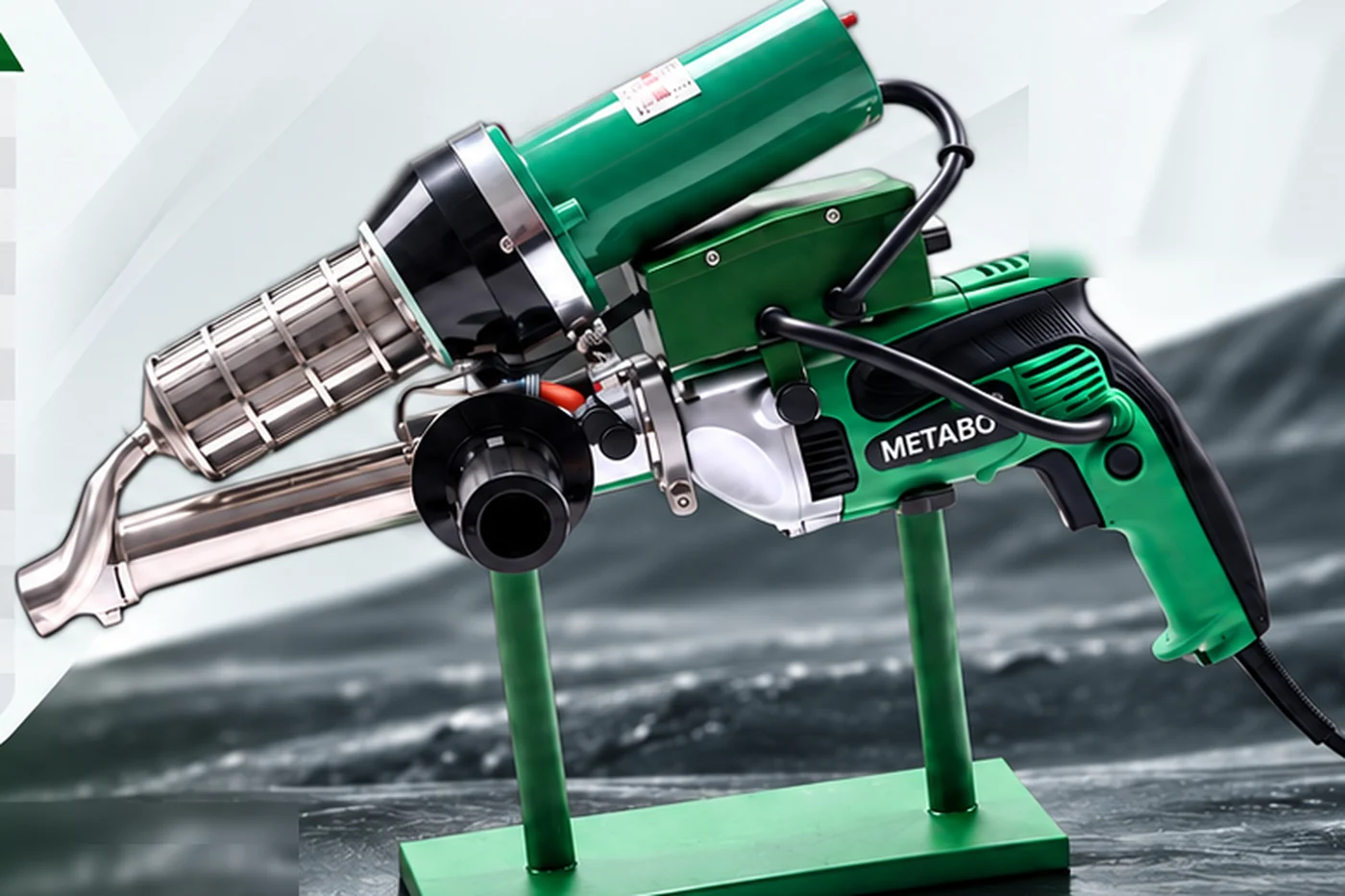
Every lining project reaches a point where the wedge welder has to stop. A pipe comes through the liner. A panel corner meets a concrete structure. A stone punctures the sheet and a patch is needed. The anchor trench turns a right angle. None of that can be welded by a machine that has to roll in a straight line, and all of it still has to be watertight.
That is the hand extrusion welder's job. It is a portable extruder: a screw inside a heated barrel melts solid welding rod and pushes the molten polymer out through a shaped shoe onto the joint, while a jet of hot air softens the sheet just ahead of the shoe so the two fuse into one mass. The operator walks the machine along the joint at the pace the output rate allows.
Where extrusion welding is used
- Patches and repairs. Any damage found during installation or by the CQA engineer is cut out, a round cornered patch is placed over it and extrusion welded around its full perimeter.
- Pipe penetrations and boots. Where a pipe passes through the liner, a fabricated boot is welded to the sheet and clamped to the pipe. All of that welding is extrusion work.
- Detail at structures. Concrete headwalls, inlet chambers, spillways and batter transitions involve short, angled seams in tight space.
- Cap strips over T-joints. Where three panels meet, the wedge seams cross and the intersection is capped and extrusion welded.
- Tank and duct fabrication. Outside lining work entirely, extruders build HDPE and PP tanks, ducting and pipe fittings.
How to run one properly
Extrusion welding is a skill, and the difference between a competent operator and a poor one is measurable in peel test results. Four things account for most failures.
Surface preparation. The weld area must be ground or abraded to remove the oxidised skin and any dust, and welded the same day. Grinding must not cut into the sheet more than about ten percent of its thickness, or the liner is weakened where it is meant to be strongest.
Preheat. The hot air stream has to actually soften the parent material ahead of the shoe. Too little and the bead sits on cold plastic and peels. Too much and the sheet distorts or scorches. Travel speed governs how long preheat is applied, so speed and air temperature are set together.
Extrudate temperature. Set for the resin, typically 210°C to 240°C for HDPE. Purge cold material from the barrel before starting a bead and never leave molten polymer sitting in a hot barrel between runs, because it degrades and the next bead carries that degraded material into the joint.
Rod match. The filler must be the same resin family as the sheet and a compatible melt grade. This is the failure that surprises people, because a mismatched bead can look completely sound.
Specification
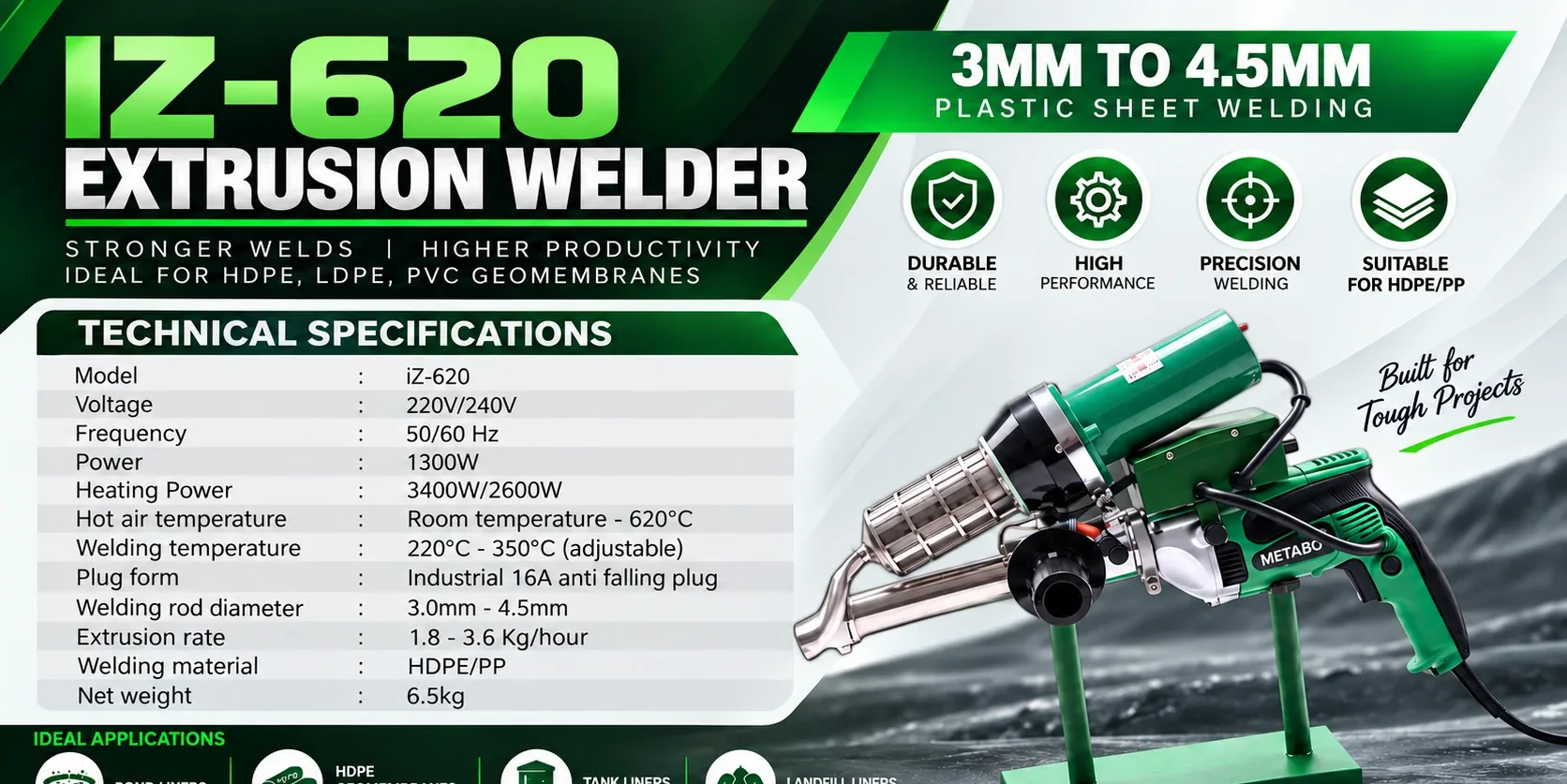
Manufacturer figures for the IZ-620 as supplied. These are the machine's rated values, not a category range.
| Parameter | Specification |
|---|---|
| Model | IZ-620 |
| Welding process | Extrusion welding, fillet or V bead |
| Welding material | HDPE and PP |
| Welding rod diameter | 3.0 mm to 4.5 mm |
| Extrusion rate | 1.8 to 3.6 kg/hour |
| Welding temperature | 220°C to 350°C, adjustable |
| Hot air temperature | Ambient to 620°C |
| Voltage | 220 V / 240 V |
| Frequency | 50 / 60 Hz |
| Motor power | 1,300 W |
| Heating power | 3,400 W / 2,600 W |
| Plug | Industrial 16 A anti-falling plug |
| Net weight | 6.5 kg |
| Applications | Pond liners, HDPE geomembrane, tank liners, landfill liners |
| Warranty | 1 year on motors and circuit boards |
Two figures deserve attention. The rod range stops at 4.5 mm, so 5 mm rod will not feed through this machine. And the welding material is HDPE and PP: this is not a PVC machine, because PVC is not extrusion welded at all. Total draw is 1,300 W for the motor plus up to 3,400 W of heating, so confirm the site supply or generator rating before ordering.
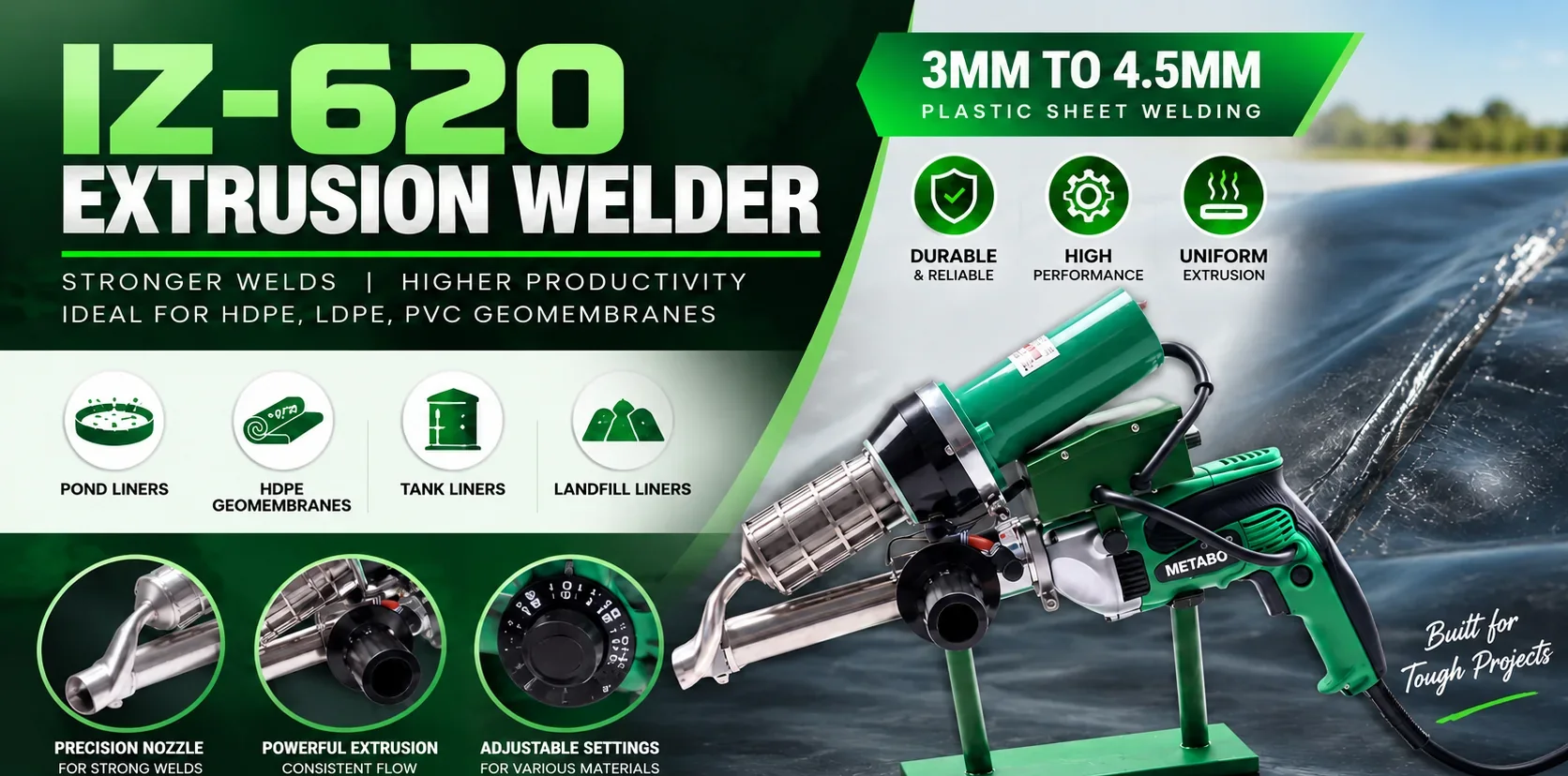
IZ-620 product sheets
Both sheets are downloadable and shareable. Right click to save, or send them from WhatsApp when a customer asks for specifications.
Choosing an output rate
Machines are described by how much polymer they can extrude per hour. Bigger is not better; it is different.
| Output rate | Rod | Best suited to |
|---|---|---|
| 1.0 to 1.8 kg/h | 3 mm | Patch work, small repairs, tight detail, overhead and confined positions. Lightest to hold for a full shift. |
| 2.0 to 3.2 kg/h | 3 mm or 4 mm | General geomembrane work. The usual choice for a lining crew carrying one extruder. The IZ-620 sits here, at 1.8 to 3.6 kg/h. |
| 3.5 to 5.0 kg/h | 4 mm or 5 mm | Continuous heavy fillet welding, thick sheet, tank and duct fabrication. Too heavy for extended detail work. |
Buy the rod with the machine
A hand extruder is useless without filler of the right grade, and rod is not something you can reliably source locally on a remote site. Order a working supply with the machine and keep it dry and clean; damp or contaminated rod produces porous beads.
Common faults and what causes them
| Symptom | Usual cause |
|---|---|
| Bead peels off the sheet cleanly | Insufficient preheat, contaminated surface, or wrong rod resin |
| Porous or bubbled bead | Damp rod, degraded material left in the barrel, or extrudate too hot |
| Bead too thin or starved | Travelling faster than the output rate supports, or rod feed slipping |
| Scorched or distorted parent sheet | Preheat air too hot or held in one place too long |
| Uneven bead profile | Worn or wrong weld shoe, or inconsistent travel speed |
| Machine stalls or trips | Cold start before the barrel reached temperature, or inadequate site power supply |
Replacement shoes, nozzles and rod feed parts are held in Dubai. See spare parts and accessories.
Frequently asked questions
What is extrusion welding?
Extrusion welding joins thermoplastics by adding new molten material to the joint. A motor driven screw inside the machine melts a solid welding rod fed in at the top, and extrudes it through a shaped shoe onto the joint. A stream of hot air from a preheat nozzle softens the parent sheet immediately ahead of the shoe, so the extrudate and the sheet fuse rather than simply sitting on top of one another. The process was developed in the 1960s as a development of hot gas welding and is now standard for thick section thermoplastic work.
What is the difference between an extrusion welder and a wedge welder?
A wedge welder melts only the existing sheet and fuses it under roller pressure, adding nothing. An extrusion welder adds new polymer from a rod. The practical consequences are large: wedge welding is faster, more consistent and produces an air testable dual track seam, so specifications require it for primary seams. Extrusion welding is slower and depends on operator skill, but it is the only process that works on patches, repairs, corners, pipe boots and anywhere a wheeled machine cannot track. Nearly every project needs both.
What are the main parts of an extrusion welding machine?
Working from the rod inlet forward: a rod feed with drive rollers pulls the filler in; a heated barrel and screw melt and convey it; a hot air blower supplies the preheat stream; the preheat nozzle directs that air onto the joint; and the weld shoe, sometimes called the PTFE shoe, shapes the extrudate as it is laid down and presses it into place. Add the drive motor, the electronic temperature controls for extrudate and air, and the handle and support. The shoe and the nozzle are the parts changed most often, because they are matched to the bead profile and the joint geometry.
What materials can be extrusion welded?
HDPE and LLDPE are the everyday materials on lining work. Polypropylene is welded the same way with PP rod and different temperature settings, and PVDF is possible on machines rated for it. What does not work is mixing resin families: PP rod on an HDPE sheet produces a bead that looks bonded and peels straight off, because the two polymers are not compatible. PVC is not extrusion welded at all in this trade; it is joined with a hot air welder.
Which welding rod diameter should I use?
Four millimetre rod is the general purpose choice for geomembrane work and covers almost all liner repairs and detailing. Three millimetre rod suits smaller machines and finer detail, and gives more control in confined geometry. Five millimetre is for high output machines doing continuous heavy fillet work, mostly on thick sheet and tank fabrication. The rod must be the same resin family and a compatible grade to the liner. See welding rod and filler for grades.
How is an extrusion weld tested?
By vacuum box, to ASTM D5641. A clear topped box is placed over the soaped seam and evacuated; bubbles reveal any leak path. Extrusion seams cannot be air channel tested because they have no channel, which is the main reason specifications restrict them to places where wedge welding is impossible. Destructive coupons are also cut and pulled to ASTM D6392 for peel and shear at set intervals. The vacuum box and pump are supplied separately from the welder.
Why is my extrusion weld peeling off the sheet?
Almost always insufficient preheat. If the parent sheet is not softened before the extrudate lands on it, the bead cools onto a cold surface and forms a mechanical bond rather than a fusion bond, and it lifts cleanly under a peel test. Other common causes are moving too fast for the output rate, a contaminated or dusty surface that was not ground back, an incorrect rod grade, and extrudate temperature set too low. Surface preparation matters: the sheet should be lightly abraded and clean, and welded the same day it is prepared, since oxidation begins immediately.
Everything here is part of the welding equipment we stock in Dubai for export.
Related pages
- Wedge welding machineThe production machine that makes the long primary seams an extruder then finishes.
- HDPE welding rodRod grade has to match the liner resin, or the bead will fail peel testing.
- Seam testing equipmentExtrusion seams are proven by vacuum box rather than air channel pressure.
- Weldy booster EX3The Leister group alternative, 3.4 kg/h, rated for geomembrane.
Get an IZ-620 quoted
Send the liner thickness, the rod diameter you use and your destination country. We will confirm the model and quote it delivered with a starter rod supply.