Weldy WGW 300 wedge welding machine
The Weldy hot wedge welder for geomembrane, rated from 0.8 mm HDPE. That lower limit is the reason it sits in our range beside the IZ-900: it welds the thin farm pond and aquaculture liner the IZ-900 cannot. 1750 W, 0 to 8.5 m/min, copper wedge, 2 x 12 mm seam, 15 kg.
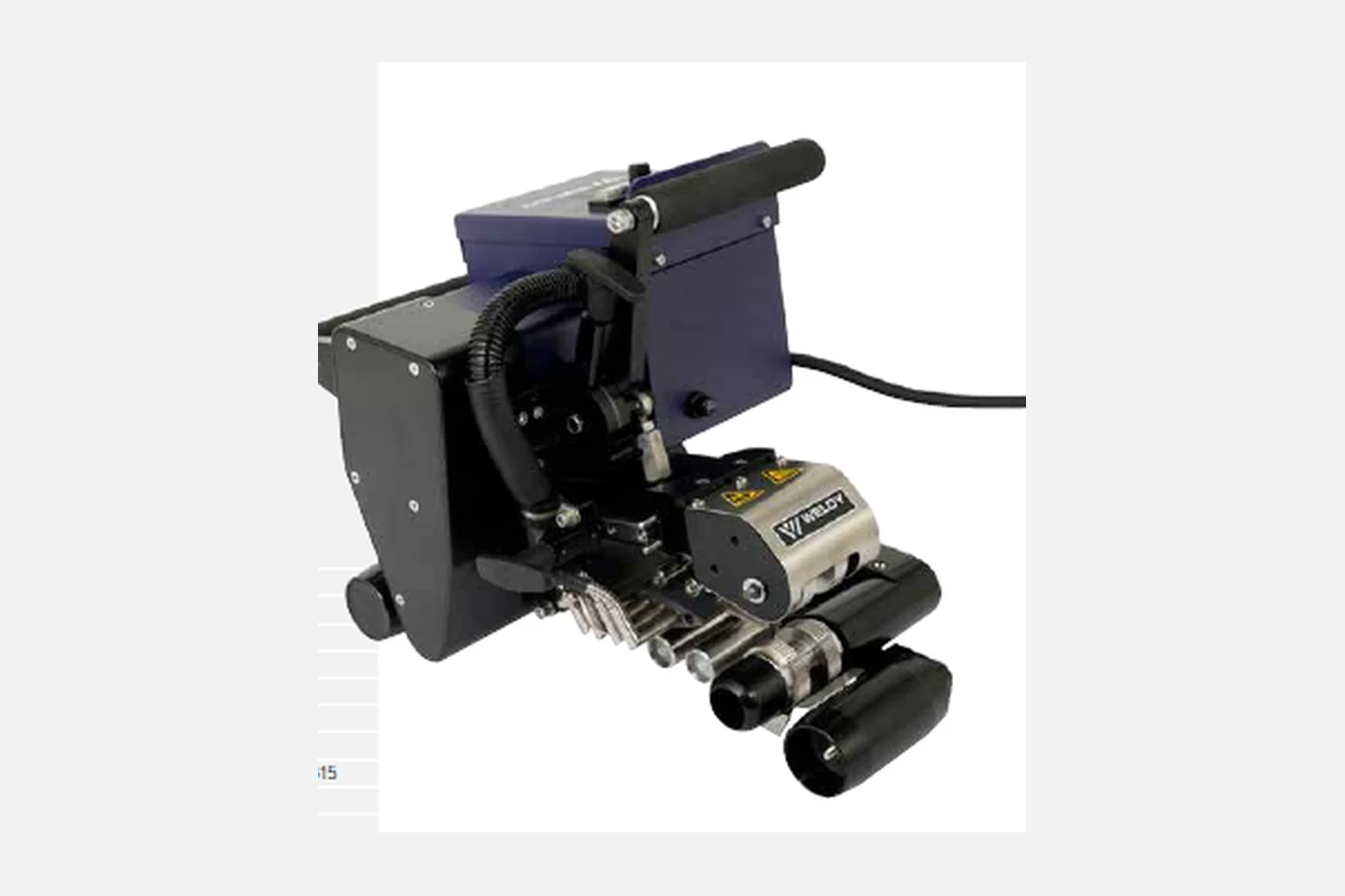
We added the WGW 300 to the range for one specific reason. Our IZ-900 is a capable wedge welder, but it is rated from 1.0 mm, and a large share of the liner sold across our export markets is 0.75 mm: farm ponds in Kenya, aquaculture in Egypt and the Philippines, water pans, seasonal storage. The WGW 300 is rated from 0.8 mm HDPE, and it closes that gap.
It is a Weldy machine, which places it in the Leister group of Swiss designed welding equipment. That matters to buyers whose specifications name a European brand, and to contractors who want parts and service support that outlasts the project.
What the machine is
A self-propelled hot wedge welder with a copper wedge, two weld tracks of 12 mm each, and large rubber drive rollers designed for uneven subgrade. Temperature and air volume are set directly on the control panel with separate displays, and speed is continuously variable from a standstill to 8.5 m/min.
At 15 kg it is heavier than the IZ-900, and that weight is doing something: it translates to joining pressure and to stability on the overlap. The transport box it ships in is a hard case, not a cardboard carton.
The PVC rule
The copper wedge is for polyethylene and other polyolefins. It is not for PVC. PVC on copper corrodes the wedge and produces seams that fail. Weldy supplies a steel wedge for PVC work, and the catalogue marks it with an asterisk for a reason. If PVC liner or coated fabric is in your programme, order the steel wedge with the machine. Changing wedges on site is straightforward; discovering the problem at a peel test is not.
Where it sits against the IZ-900
Both are dual track hot wedge welders. Both produce a seam that can be air pressure tested. Both are held in Dubai. The differences are these.
Specification
Figures from the Weldy catalogue for the WGW 300 as supplied. Article number 802.235, 230 V with industrial plug.
| Parameter | Specification |
|---|---|
| Model | Weldy WGW 300 |
| Article number | 802.235 |
| Welding process | Hot wedge, dual track |
| Voltage | 230 V |
| Maximum power | 1,750 W |
| Temperature | Up to approximately 450°C |
| Hot wedge material | Copper as standard; steel wedge for PVC |
| Weld seam width | 2 × 12 mm |
| Maximum overlap | 150 mm |
| Welding speed | 0.0 to 8.5 m/min |
| HDPE | 0.8 mm to 2.5 mm |
| LDPE, TPO, FPO, PVC | 0.8 mm to 3.0 mm; PVC only with the steel wedge |
| Geotextile | Weldable |
| Dimensions, L × W × H | 445 × 323 × 315 mm |
| Weight | 15 kg |
| Protection class | I, earthed |
| Delivery contents | Machine, instruction manual, transport box, 3 Allen keys, spare fuses, cleaning brush |
| Sales territory | Not sold into EU or EFTA countries |
Two lines matter. The 0.8 mm lower limit on HDPE is what separates this machine from the IZ-900, which starts at 1.0 mm. And the PVC note is a hard rule, not a suggestion: the copper wedge is for polyolefins, and welding PVC on it damages both. Order the steel wedge if PVC is in your programme.
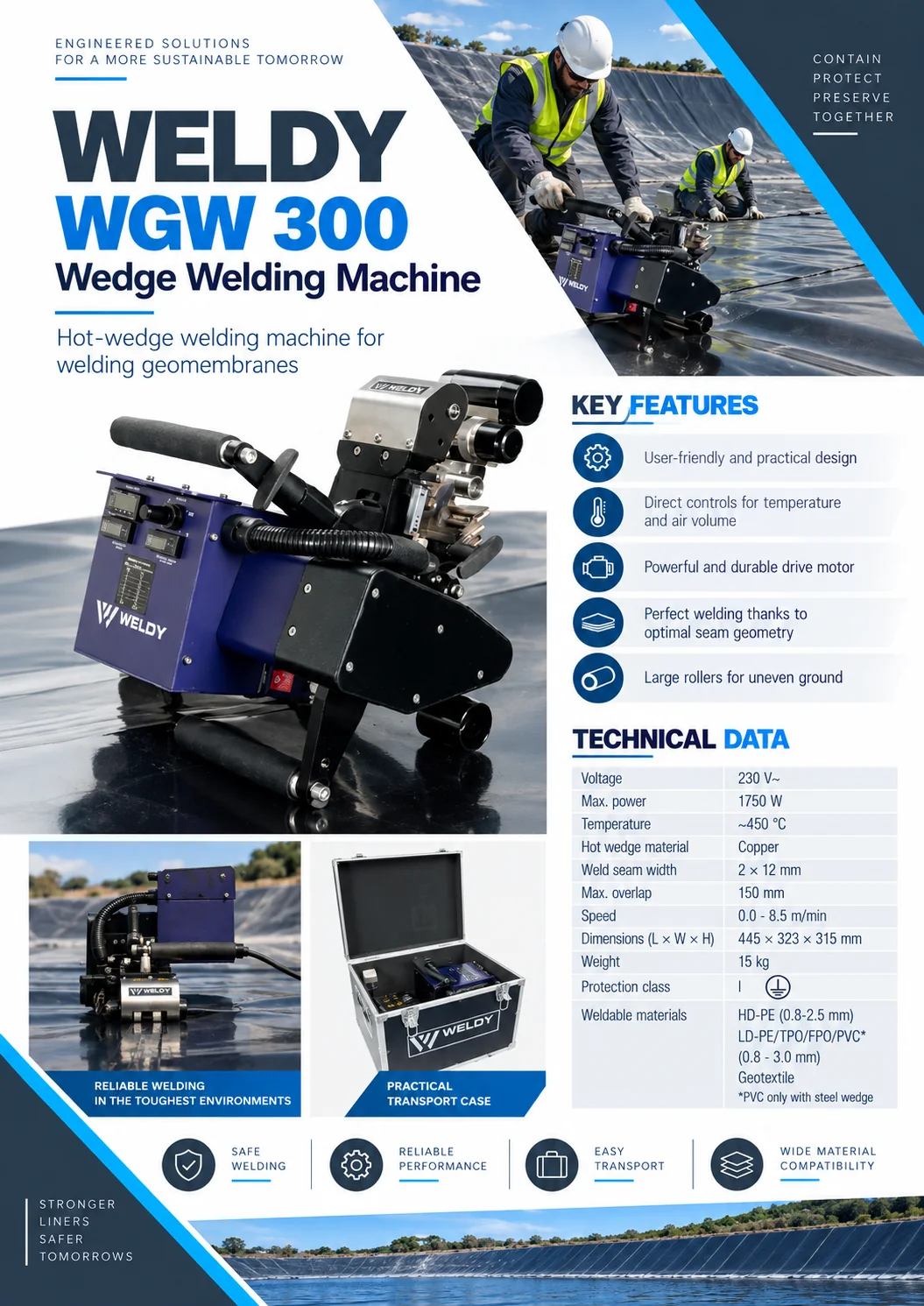
Weldy datasheet
The manufacturer's product sheet. Right click to save, or send it from WhatsApp when a customer asks for the Weldy specification.
| Property | Weldy WGW 300 | IZ-900 |
|---|---|---|
| HDPE thickness range | 0.8 to 2.5 mm | 1.0 to 3.0 mm |
| Welding speed | 0.0 to 8.5 m/min | 1 to 7 m/min |
| Power | 1,750 W | 2,100 W |
| Wedge | Copper, steel for PVC | Standard heating plate |
| Seam | 2 × 12 mm | 2 × 16 mm, 12 mm cavity |
| Weight | 15 kg | 13 kg |
| Brand | Weldy, Leister group | Geomembrane Welding Machine |
| Transport | Hard transport box | Carton |
| Best for | Thin liner, brand-specified projects | 1.0 mm and above, price-led purchases |
Where a project specification names a European brand, the WGW 300 satisfies it and the IZ-900 does not. Where price decides and the liner is 1.0 mm or heavier, the IZ-900 is the sensible choice.
Thin liner is the whole point
If you are buying one wedge welder and your work includes farm ponds, water pans or fish ponds, the 0.8 mm rating is the deciding line. A 1.0 mm machine on 0.75 mm sheet burns through, and no setting fixes that. This is the machine for that work.
Frequently asked questions
What thickness does the Weldy WGW 300 weld?
HDPE from 0.8 mm to 2.5 mm, and LDPE, TPO, FPO and PVC from 0.8 mm to 3.0 mm. The lower limit is the significant number. Most wedge welders in this class, including our IZ-900, are rated from 1.0 mm, which leaves the 0.75 mm liner used on farm ponds, water pans and aquaculture out of reach. The WGW 300 is the machine we point buyers at when that gauge is in their programme.
Can the WGW 300 weld PVC geomembrane?
Yes, but only with the steel wedge. The machine ships with a copper wedge, which is the right material for polyethylene and other polyolefins. PVC on a copper wedge damages the wedge and produces poor seams. If PVC liner or PVC coated fabric is part of your work, say so at enquiry and the steel wedge is supplied with the machine.
What does 0.0 to 8.5 m/min actually mean in practice?
The machine will travel at up to 8.5 metres a minute, but production speed is set by the liner and the conditions, not by the motor. On 0.8 mm sheet in mild conditions you might run 4 to 5 m/min. On 2.5 mm mining liner you will run far slower because the wedge has to deliver heat through much more material. The value of a wide speed range is control at the slow end, not the number at the fast end. Starting figures by gauge are in our settings guide.
Why is the WGW 300 not sold in the EU?
Weldy restricts sales of this model outside EU and EFTA countries, which the catalogue states plainly. That is a commercial decision by the manufacturer, and it does not affect buyers in the Gulf, Africa or Asia, which is where we ship. It does mean the machine is built for exactly the markets we serve rather than adapted from a European specification.
How does the WGW 300 compare with the IZ-900?
The WGW 300 is the premium option: a Weldy branded machine with a wider speed range, a copper wedge, twin displays and a Leister group pedigree, rated from 0.8 mm. The IZ-900 is our own-brand machine, rated from 1.0 mm, with a 12 mm test cavity between wider 16 mm tracks, and it costs meaningfully less. If everything you weld is 1.0 mm and above, the IZ-900 does the job. If 0.75 mm liner is in your work, or a specification names a European brand, the WGW 300 is the answer.
What is in the box?
The machine, the instruction manual, a transport box, three Allen keys, spare fuses and a cleaning brush. The copper wedge is fitted. The steel wedge for PVC is a separate item. Air pressure test equipment for the dual track channel is not included and is listed under seam testing.
The full equipment list sits on our geomembrane welding equipment page.
Related pages
- IZ-900 wedge welderOur own-brand wedge welder for 1.0 to 3.0 mm, at a lower price point.
- Weldy booster EX3The extruder Weldy rates highest for geomembrane detail work.
- Seam testing equipmentAir pressure kit for the dual track channel this machine leaves.
- HDPE pond linerThe 0.75 mm sheet this machine was added to the range to weld.
Get a WGW 300 quoted to your site
Tell us the thinnest liner you weld and the destination country. We will confirm the WGW 300 is the right choice and quote it delivered, with the steel wedge if PVC is involved.