HDPE welding rod for geomembrane welding
4 mm HDPE welding rod is the everyday size for geomembrane work, and we stock it in black, blue, white and green, along with LDPE, PP and PVC. It is the cheapest item in a lining crew's kit and the one most often responsible for a failed seam.
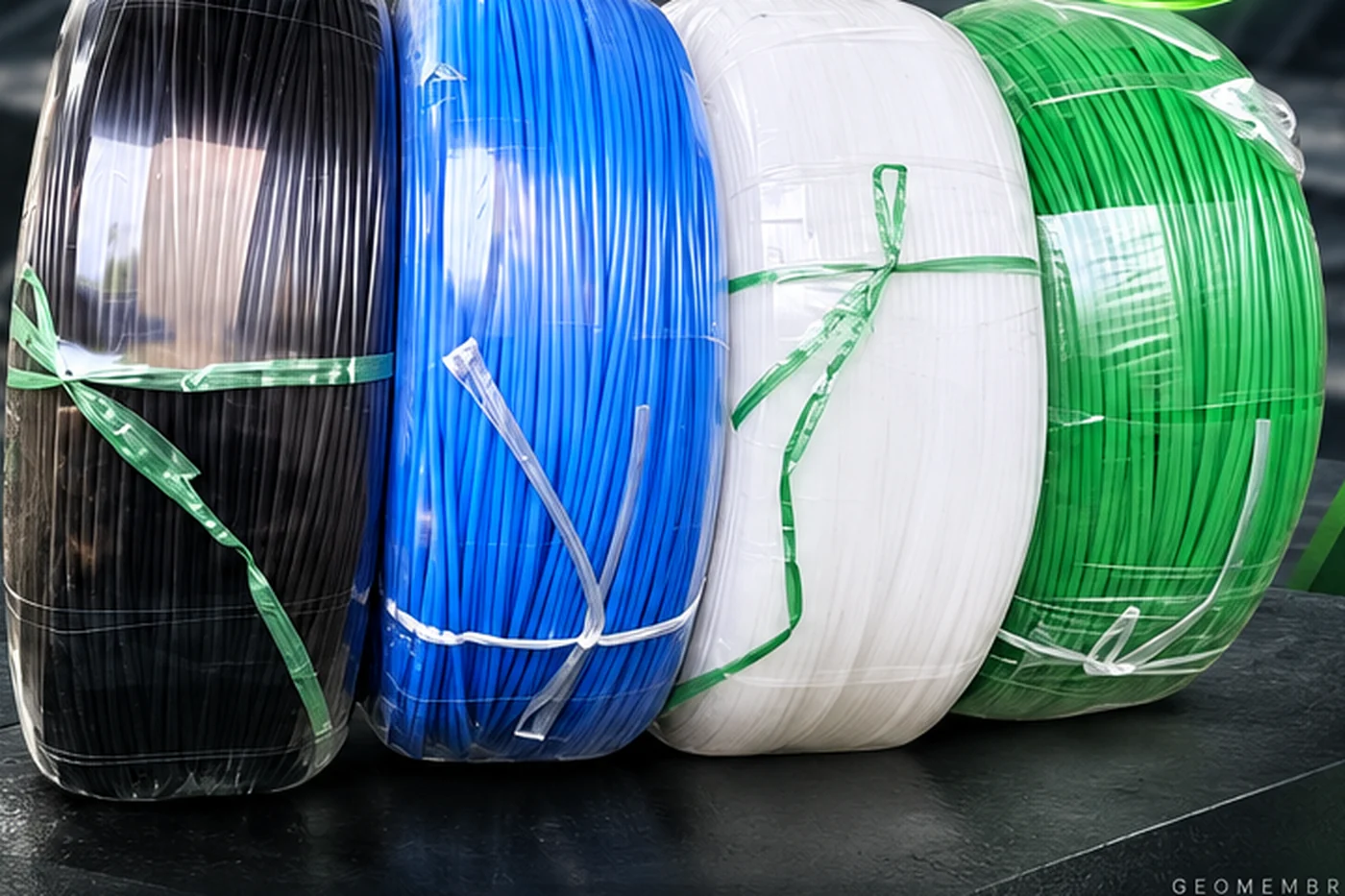
Extrusion welding adds material to a joint. That material becomes part of the liner and carries load exactly as the sheet does, which means it has to be the same kind of plastic, in a compatible grade, clean and dry when it enters the machine. None of that is expensive or complicated. It is simply the part of the job most often got wrong.
Grade compatibility is the whole issue
Polyethylene fuses to polyethylene. It does not fuse to polypropylene, and no amount of heat or technique changes that. A PP rod laid on HDPE liner forms a bead that sits on the surface, looks correct to the eye, survives handling, and fails at the first peel coupon. By that point it may be present on dozens of penetrations across the site.
Within polyethylene, grade still matters. Rod should be close in density and melt flow to the sheet, which for the liner we supply means a rod around 0.940 to 0.950 g/cc against sheet with a minimum average density of 0.940 g/cc. Where a project specification names a rod, buy that rod. Where it does not, buy rod from the same source as the sheet so compatibility is somebody's responsibility rather than an assumption.
Colour is not a cosmetic choice
We stock rod in black, blue, white and green, and buyers reasonably assume the difference is appearance. On a geomembrane it is not.
Black rod carries 2 to 3 percent carbon black, and carbon black is what protects polyethylene from ultraviolet light. It is the same reason liner itself is black. Coloured rod does not have that protection, so a white or blue bead on an exposed liner will degrade faster than the sheet around it. The repair becomes the weak point in a structure you repaired.
So for geomembrane work, buried or exposed, use black. The coloured grades exist for tank and duct fabrication, pipework, and indoor or covered work where the weld never sees sunlight, and for jobs where a contrasting bead makes inspection easier. If you are welding a liner, order black and keep the colours for the workshop.
Handling and storage on site
Rod arrives clean. What happens to it afterwards is what determines whether the beads made from it are sound.
- Keep it bagged. An open coil in a site container collects dust, and that dust goes into the joint.
- Keep it dry. Absorbed moisture flashes to steam in the barrel and produces a porous bead. Porosity is a leak path.
- Keep it out of the sun. Rod baking on a pallet in Gulf summer conditions is not doing itself any good, even carbon black stabilised.
- Wipe it before feeding. A cloth pass as the rod enters the machine costs nothing and removes surface contamination.
- Separate the resins. If you carry both PE and PP rod, mark and store them apart. Black rod all looks identical in a site container.
Specification
Rod is stocked in the resins and diameters that cover normal lining work. Specialist grades are available to order against a project specification.
| Parameter | Typical range |
|---|---|
| Headline size | 4 mm, the general purpose geomembrane diameter |
| Diameters stocked | 3 mm, 4 mm, 4.5 mm, 5 mm |
| Resins | HDPE, LDPE, PP, and PVC for hot air work |
| Colours | Black, blue, white, green |
| For geomembrane | Black, carbon black stabilised |
| Cross section | Round, standard for hand extruders |
| Density, HDPE rod | 0.940 to 0.950 g/cc |
| Carbon black content, black rod | 2.0 to 3.0 percent |
| Supply form | Wrapped coils, or cut lengths for confined work |
| Fits the IZ-620 | 3.0 mm to 4.5 mm. 5 mm will not feed |
| Storage | Dry, sealed, out of direct sunlight |
| Certification | Resin certificate available on request |
Rod diameter must suit the machine, not the job. Our IZ-620 extruder takes 3.0 mm to 4.5 mm, so 5 mm rod will not feed through it. Check the machine specification before ordering a consignment, because a pallet of the wrong diameter is an expensive mistake to discover on site.
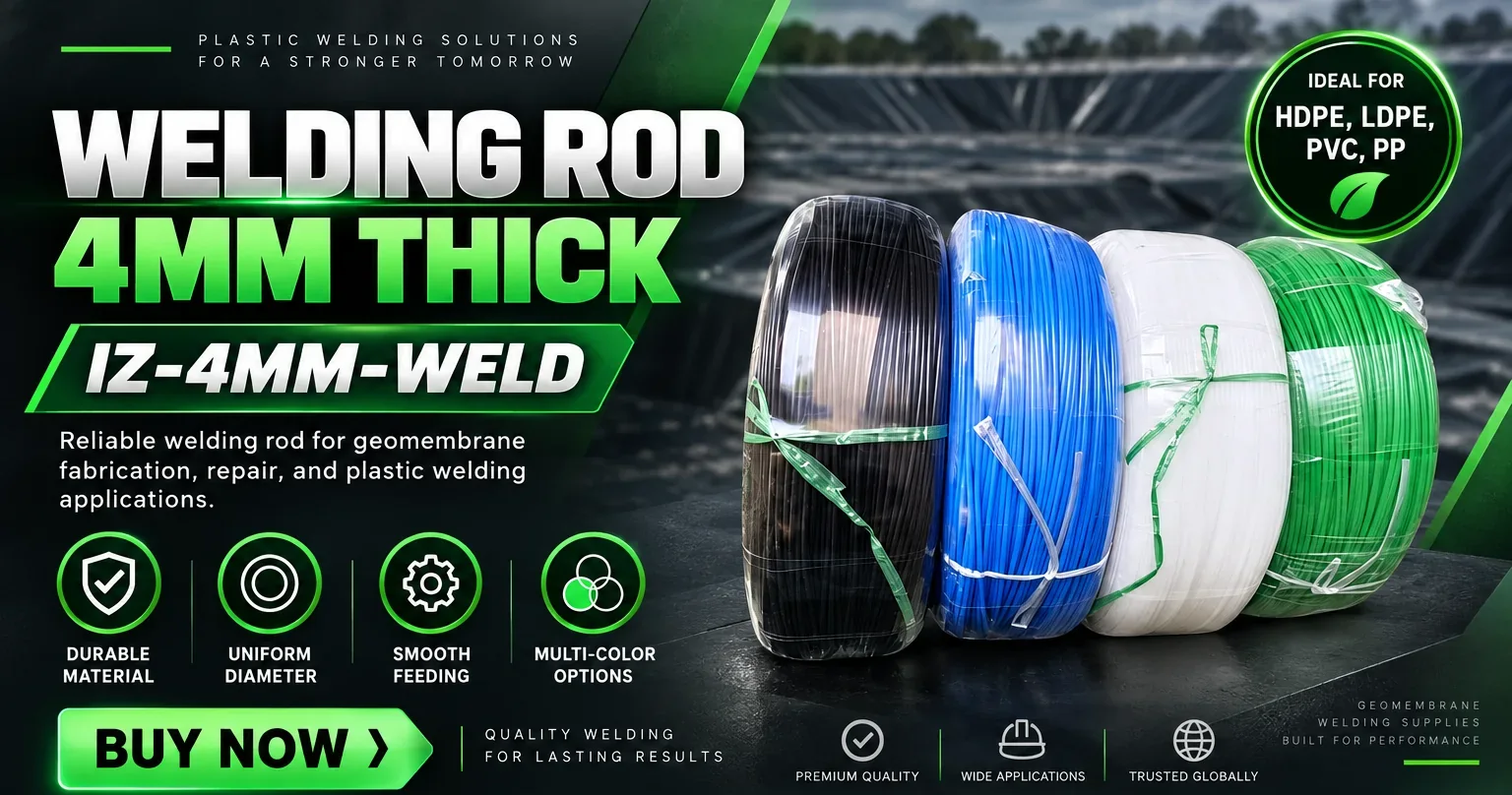
Welding rod product sheet
Downloadable and shareable. Right click to save, or send it from WhatsApp when a customer asks what we stock.
Choosing rod for the liner you are welding
| Liner material | Rod resin | Usual diameter | Notes |
|---|---|---|---|
| HDPE geomembrane, 0.75 to 1.50 mm | HDPE | 3 mm or 4 mm | General lining work. 4 mm on most crews. |
| HDPE geomembrane, 2.00 to 3.00 mm | HDPE | 4 mm or 5 mm | Heavier sections need more deposited material per pass. |
| LLDPE geomembrane | LLDPE | 3 mm or 4 mm | Use LLDPE rod, not HDPE, to keep flexibility matched. |
| Polypropylene sheet and tanks | PP | 3 mm or 4 mm | Different temperature settings. Purge the barrel first. |
| PVC membrane and fabric | PVC | 3 mm or 4 mm | Hot air only. We stock PVC rod, but it is fed by hand into a hot air gun, never through an extruder. |
Buy rod and sheet together where you can
Ordering liner and filler from one supplier removes the compatibility question entirely, and lets both travel in the same consignment. We supply HDPE geomembrane sheet alongside the equipment for exactly this reason.
Frequently asked questions
What welding rod is used for HDPE geomembrane?
HDPE extrusion welding rod, carbon black stabilised, in the same resin family and a compatible melt flow grade as the liner. For lining work the everyday size is 4 mm round rod, with 3 mm used on smaller machines and in tight detail. The rod must come from a polyethylene resin, not polypropylene, and its density should sit close to the sheet it is welding. Where a project specification names a rod grade, it takes precedence over general practice.
Can I use PP rod on HDPE liner?
No. Polypropylene and polyethylene are different polymer families and do not fuse together. A PP bead laid on an HDPE sheet will appear to bond, hold its shape and look entirely normal, then separate cleanly the first time it is peel tested or loaded. This is one of the most damaging errors on a lining site because it is invisible until testing. Keep PP and PE rod stored separately and clearly marked, and purge the barrel of your extruder when changing resin.
How much welding rod does a project need?
It depends on detail volume rather than on total liner area, and the two are only loosely related. A large, simple reservoir with long uninterrupted panels uses very little rod because almost every seam is wedge welded. A small tank farm bund with dense pipework and dozens of penetrations consumes far more per square metre. As a working rule, budget rod against the number of penetrations, patches, cap strips and metres of detail seam, and carry a surplus, because running out mid-project on a remote site stops the job.
Does welding rod expire?
Rod does not have a shelf life in the way an adhesive does, but it degrades in storage. Ultraviolet exposure, moisture absorption and surface contamination all affect the bead. Damp rod produces porosity, and dusty or oily rod carries contamination directly into the joint. Store it sealed, off the ground, out of direct sunlight, and keep partly used coils bagged. Rod that has sat uncovered on a site for a season should be treated with suspicion.
What diameter rod should I buy?
Match the machine first. Most hand extruders take either 3 mm or 4 mm and will not run the other size reliably. Where the machine takes both, 4 mm gives higher output and suits continuous fillet work, while 3 mm gives finer control in corners, around pipe boots and in confined positions. Five millimetre rod belongs with high output machines doing heavy fabrication rather than liner repair.
For the full picture, see what we hold as a geomembrane welding machine supplier in Dubai.
Related pages
- Extrusion welding machineThe machine the rod feeds, with output rates and operating technique.
- Seam testing equipmentVacuum box testing is how an extrusion bead made with this rod gets proven.
- Liner specificationsSeam peel and shear values the finished extrusion bead has to reach.
- Spare partsRod feed rollers and drive parts wear, and a slipping feed starves the bead.
Order 4 mm HDPE rod with your machine
Rod is not something you can reliably buy near a remote site. Tell us the liner grade and the volume of detail work and we will quote a working supply.