Geomembrane seam testing equipment
A weld that has not been tested is not a weld the engineer will accept. Air pressure kit proves dual track wedge seams, vacuum boxes prove extrusion seams, and a field tensiometer turns coupons into numbers that go in the quality record.
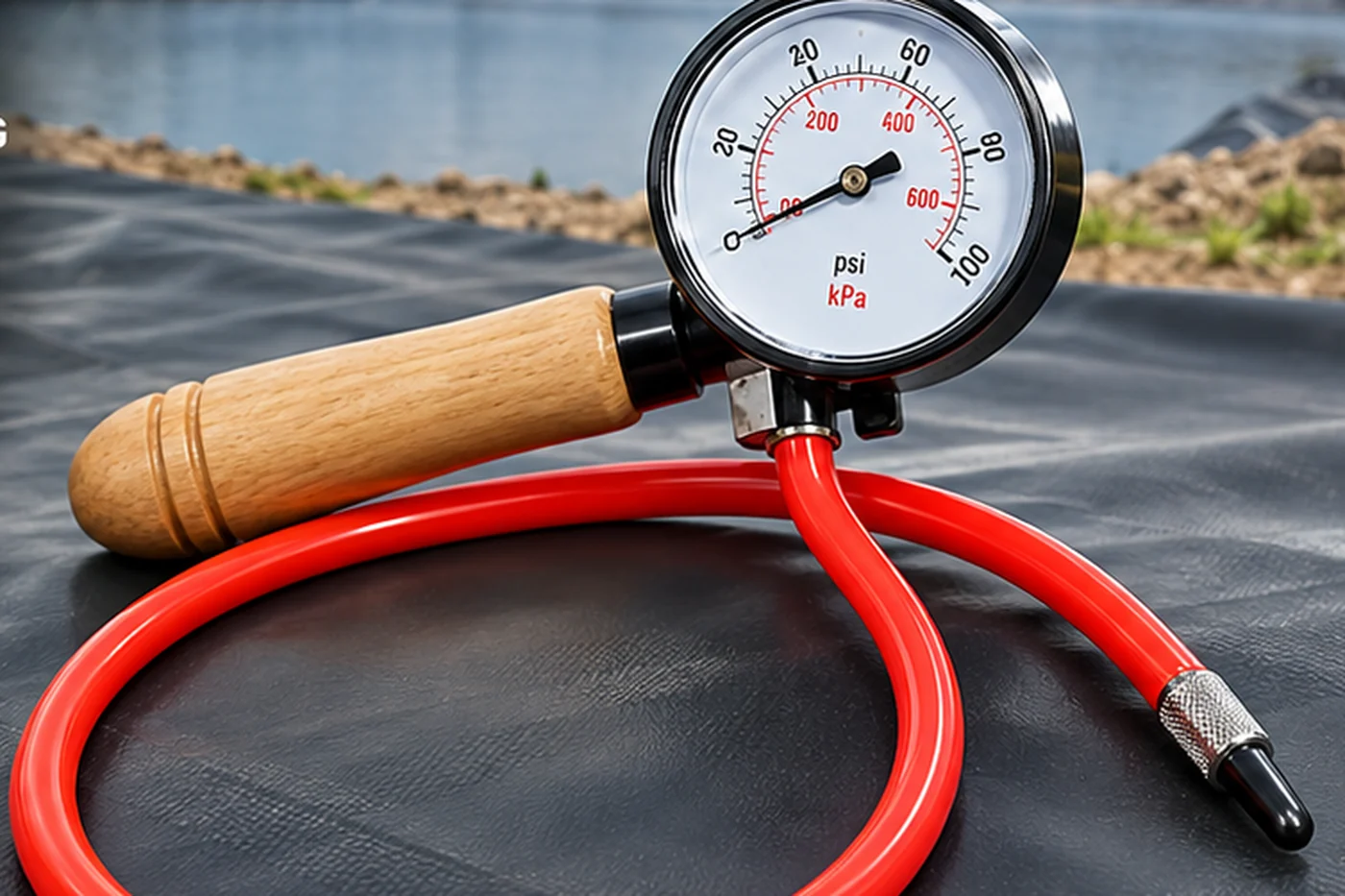
Every geomembrane specification contains an acceptance clause, and every acceptance clause turns on a test. A seam that has been welded but not tested has no status: the engineer cannot sign it off, the CQA consultant cannot record it, and the client has no basis to accept the structure. Test equipment is therefore not an optional extra alongside the welding machine. It is the other half of the same purchase.
Two non-destructive tests, chosen by seam type
The way a seam is welded determines how it can be proven, which is the practical reason specifications care so much about welding process.
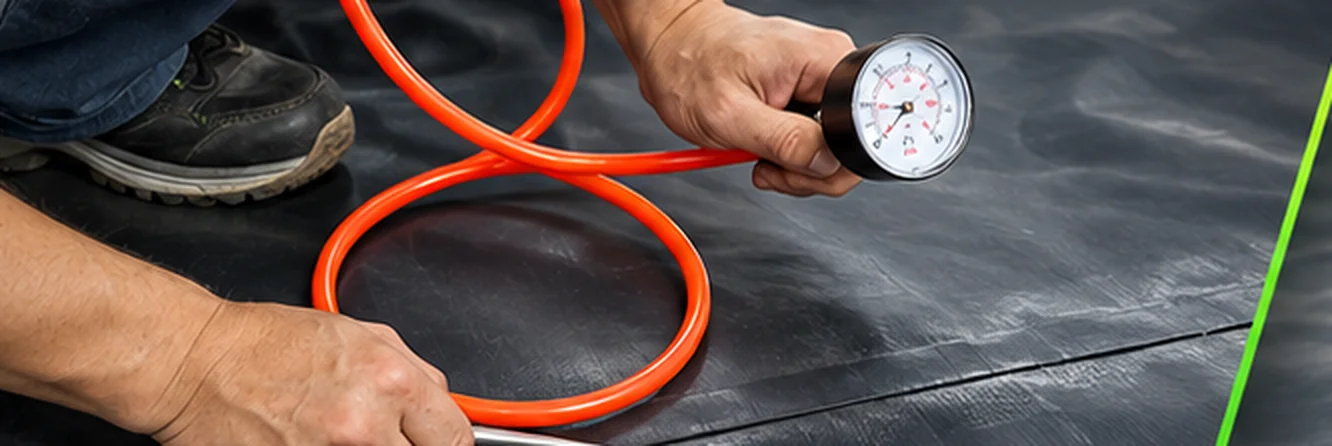
Air pressure testing applies to dual track wedge seams. The unwelded channel between the two weld tracks is sealed at both ends, pressurised through an insertion needle, and held. One operation tests the entire seam length, which on a reservoir may be a hundred metres or more, and produces a single recorded number. Nothing is cut and nothing is damaged.
Vacuum box testing applies to everything else: extrusion welds, patches, cap strips, boot welds and repairs. The box is placed over a soaped seam and evacuated, and leaks show as bubbles. It works, but it is positional and slow, testing only the length of the box at a time.
Destructive testing and why the failure mode matters
Alongside the non-destructive regime, coupons are cut from production seams at intervals and pulled in a field tensiometer. Two properties are measured: shear strength, pulling the seam in plane, and peel strength, pulling the sheets apart at the weld.
The number is only half the result. What the CQA engineer looks for is where the sample broke. A sound weld fails in the parent sheet away from the seam, because the weld is stronger than the material around it. A weld that separates at the interface between the two sheets has failed, even if the recorded load looks acceptable, because it demonstrates the sheets were pressed together rather than fused. This is the check that catches cold seams produced by excessive welding speed.
Specification
Four instruments cover the testing regime on a normal geomembrane project. Which you need depends on which welding processes the specification permits.
| Parameter | Typical range |
|---|---|
| Air pressure test kit, supplied | Dual scale gauge, flexible hose, insertion needle, handle |
| Gauge range | 0 to 100 psi / 0 to 700 kPa, dual scale |
| Standard satisfied | ASTM D5820, dual track wedge seams |
| Typical test pressure | 190 to 210 kPa, around 28 to 30 psi |
| Typical hold period | 5 minutes, with a maximum permitted pressure drop |
| Hose | Flexible, high visibility, for working along a seam |
| Needle | Stainless insertion needle for the seam test channel |
| Materials suited | HDPE, LDPE and PVC geomembrane |
| Also available | Vacuum box and pump, ASTM D5641 |
| Also available | Field tensiometer for peel and shear, ASTM D6392 |
| Also available | Spark tester for conductive backed liner |
The dual scale matters more than it looks. Specifications in this region are written in kPa while a lot of imported equipment reads in psi only, and converting in your head at 06:00 on a site is how test records end up wrong. A gauge carrying both scales removes the arithmetic. Test pressures and hold periods are set by the project specification and vary with liner thickness and ambient temperature, so work to your CQA plan rather than the typical figures above.
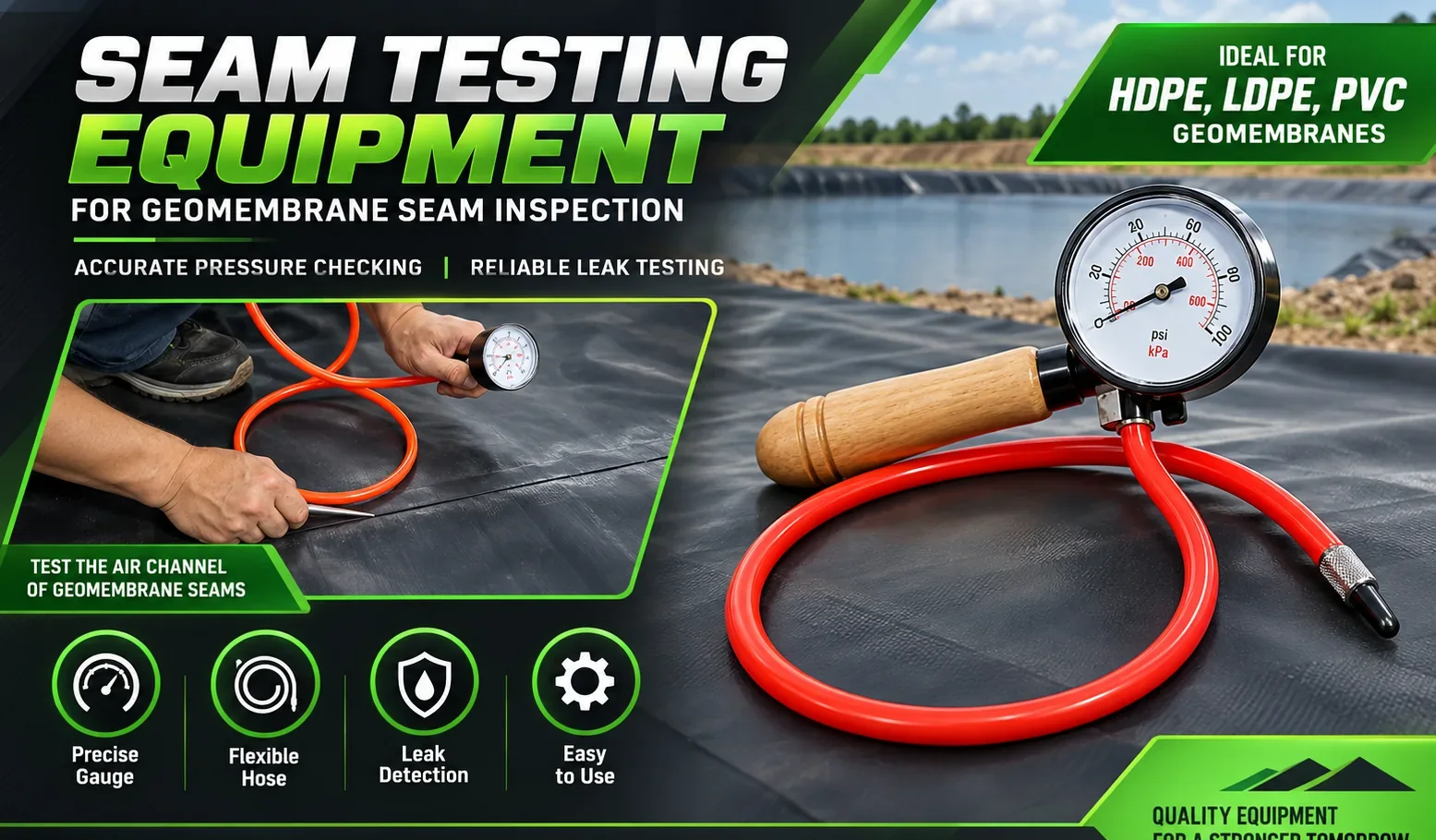
Seam testing product sheet
Downloadable and shareable. Right click to save, or send it from WhatsApp when a customer asks what the test kit includes.
Which equipment your project needs
| Seam or feature | Test method | Standard | Equipment |
|---|---|---|---|
| Dual track wedge production seam | Air pressure | ASTM D5820 | Pump, gauge, needles |
| Extrusion fillet weld | Vacuum box | ASTM D5641 | Vacuum box and pump |
| Patch or repair | Vacuum box | ASTM D5641 | Vacuum box and pump |
| Pipe penetration boot | Vacuum box, sometimes spark | ASTM D5641 | Vacuum box, spark tester |
| Trial and production coupons | Peel and shear | ASTM D6392 | Field tensiometer, coupon cutter |
| Conductive backed liner | Spark test | Project specific | Spark tester |
Trial welds come before production welds
The tensiometer earns its cost at the start of each shift, not at the end of the job. A trial weld on offcuts, cut into coupons and pulled on the spot, confirms that the day's machine settings actually produce a compliant seam. Finding out at that point costs ten minutes. Finding out from production coupons a week later costs the seams welded in between.
Frequently asked questions
How is a geomembrane seam tested?
By method matched to how the seam was made. A dual track wedge seam has a sealed channel running through it, so a needle is inserted at one end, the channel is pressurised with air, and the gauge is watched for a set hold period. If pressure holds, every metre of that seam is sound. An extrusion seam has no channel, so a vacuum box is placed over the soaped seam and evacuated, and bubbles reveal leaks. Alongside both, coupons are cut at intervals and pulled in a tensiometer for peel and shear strength.
What is an air pressure test on a wedge seam?
The test defined by ASTM D5820. Both ends of the seam channel are sealed, a needle is inserted, and the channel is brought up to the pressure the specification requires, commonly around 200 kPa. The pressure is allowed to stabilise, then held for a set period, usually five minutes, and the drop is recorded. A drop larger than permitted means a leak somewhere along that run and the seam is investigated and repaired. The far end is then cut to confirm the channel was actually open and the test was valid.
What is a vacuum box used for?
Testing seams that cannot be air tested: extrusion welds, patches, cap strips, pipe boot welds and repairs. A box with a transparent top and a foam gasket is placed over the seam, which has been wetted with soap solution. A pump draws the box down below atmospheric pressure, and any leak path pulls air through the soap film and produces visible bubbles. It is slow, because each box length has to be positioned and evacuated individually, which is another reason specifications prefer wedge welding for long seams.
What are peel and shear tests?
Destructive tests carried out on coupons cut from the finished seam at intervals set by the CQA plan. A shear test pulls the seam in the plane of the sheet and measures the load it carries. A peel test pulls the two sheets apart at the seam and measures both the load and the failure mode. Failure mode matters as much as the number: the seam should fail outside the weld in the parent sheet, not by separating at the weld interface. Both are carried out to ASTM D6392, against the strength values in the liner specification.
Do I need testing equipment if I only weld small jobs?
If the work is being handed over to a client, an engineer or a consultant, then yes, because the acceptance criteria will name a test. If the work is genuinely informal, a hand pump and needle for the wedge seams and a small vacuum box for the detail is a modest purchase that still catches faults before water goes in. The expensive scenario is discovering a leak after a reservoir is filled and a liner is under load, when finding it means draining the structure.
Can testing be done in high ambient temperature?
It has to be, in this region, but temperature affects the result. Air expands as the liner heats through the day, so a channel pressurised in the early morning and read in full sun can show a rise rather than a drop. Conversely a seam tested in falling temperature shows a drop that is thermal rather than a leak. Good practice is to allow the channel to stabilise before starting the hold period, and to record ambient conditions with the test result so the reading can be interpreted properly.
All of this is backed by the machine range we stock and export from Dubai.
Related pages
- Wedge welding machineThe dual track weld exists specifically so that this air test can be carried out.
- Extrusion welding machineExtrusion seams have no air channel, so they are proven by vacuum box instead.
- Liner specificationsSeam peel and shear values every gauge must reach under ASTM D6392.
- Guides and resourcesHow each test is carried out in the field, and what a failure actually tells you.
Get an air pressure test kit quoted
Buying the welder without the test equipment leaves you unable to hand over the work. Send your specification and we will quote the complete package.