HDPE root barrier membrane
A 0.20 mm carbon black stabilised HDPE sheet installed vertically to deflect tree and shrub roots away from foundations, pavements, services and waterproofing. Supplied from Dubai alongside our liner range.
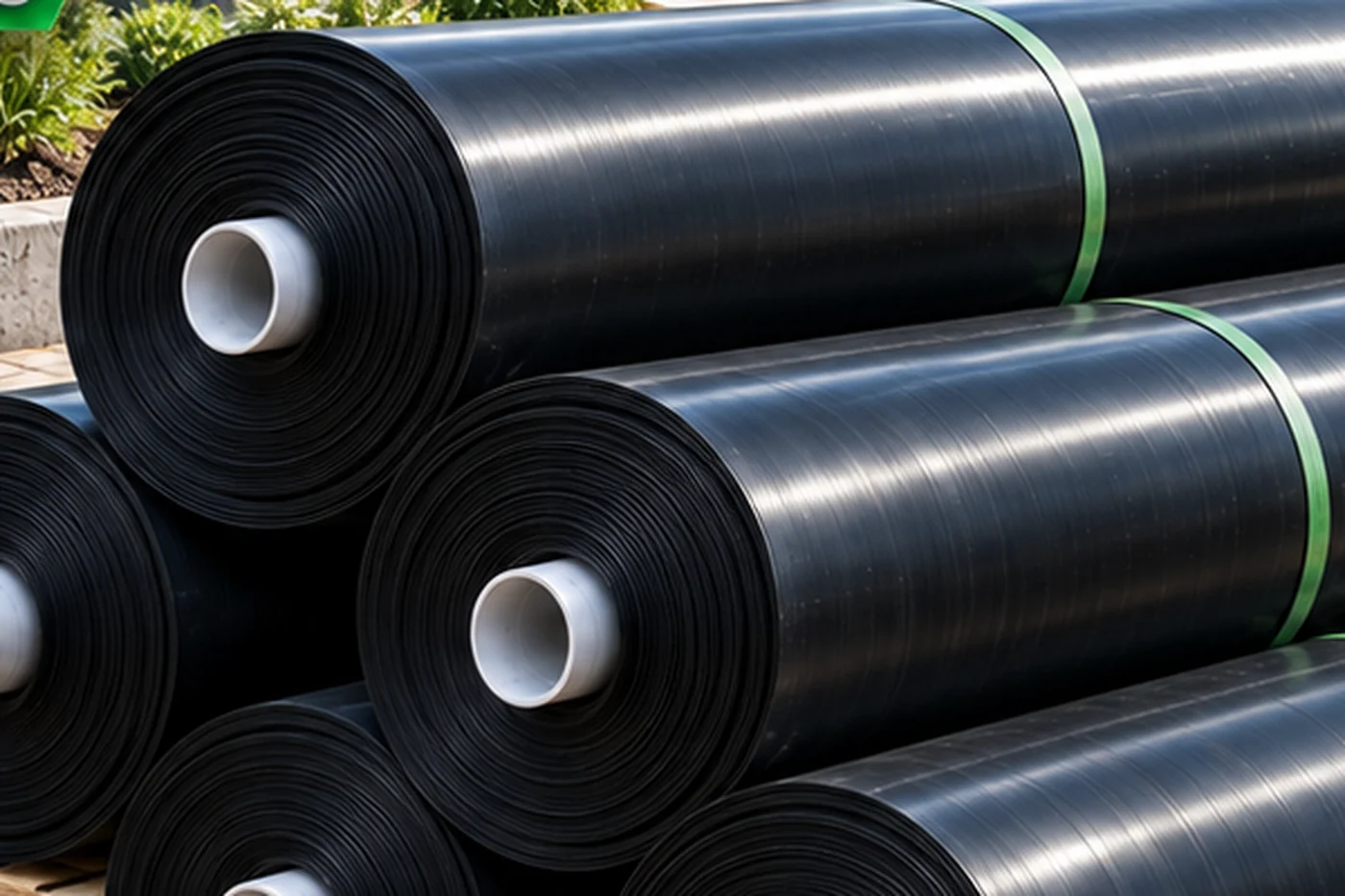
Roots go where the water and the air are, and they are indifferent to what is in the way. A mature tree twelve metres from a building can reach its foundation. A row of palms along a boulevard will lift the pavement beside them within a few seasons. Roots find service trenches, because backfill is looser and better aerated than the surrounding ground, and follow them.
A root barrier does not kill or poison anything. It is a physical sheet, set vertically between the planting and whatever needs protecting. Roots meet it and are deflected along it, downward or sideways, past the thing at risk.
Where it is used
- Street trees and boulevard planting. Protecting kerbs, footpaths and carriageway edges from surface rooting, a constant issue with the species used across the Gulf.
- Near foundations and structures. Where planting sits closer to a building than the species would normally allow.
- Podium decks and planters. Protecting the waterproofing beneath raised planting, where a root breach means finding and repairing a leak under a built deck.
- Service corridors. Keeping roots out of drainage runs, ducts and irrigation lines.
- Between planting zones. Containing vigorous or spreading species within a designed area.
Installing it
The barrier is set vertically in a trench, on the side of the planting facing whatever is being protected, and backfilled. Three details decide whether it works.
Depth. It has to reach below the main lateral rooting zone, or roots simply pass underneath. The design should state it; guessing shallow is the commonest failure.
Top edge. Bring it to just below finished level, or slightly proud where surface rooting is expected. A barrier buried 150 mm down is an invitation for roots to grow over the top.
Joints. Overlap generously and orient the lap so a root travelling along the sheet is deflected past the joint rather than into it.
Not a liner, and not a substitute for one
At 0.20 mm this membrane deflects roots. It is not rated for hydraulic containment, it carries no seam strength requirement, and it should never be specified where a pond, lagoon or bund needs to hold water. That work needs geomembrane liner at 0.75 mm or above, welded and tested.
Specification
The grade we stock for landscape and civil root protection work. Heavier sections are available from the liner range where a design calls for them.
| Parameter | Typical range |
|---|---|
| Material | High-density polyethylene, virgin resin |
| Thickness | 0.20 mm |
| Colour | Black, carbon black stabilised |
| Surface | Smooth |
| Function | Vertical root deflection |
| Typical installed depth | 600 mm to 1000 mm, design dependent |
| Jointing | Overlap, typically 300 mm or more |
| Chemical treatment | None. Physical barrier only |
| UV stability | Carbon black stabilised for handling and installation exposure |
| Supply form | Rolls, cut to the depth required |
At 0.20 mm this is a deflection membrane, not a structural liner. It is not a substitute for geomembrane where containment, hydraulic head or load is involved, and it should not be specified as one.
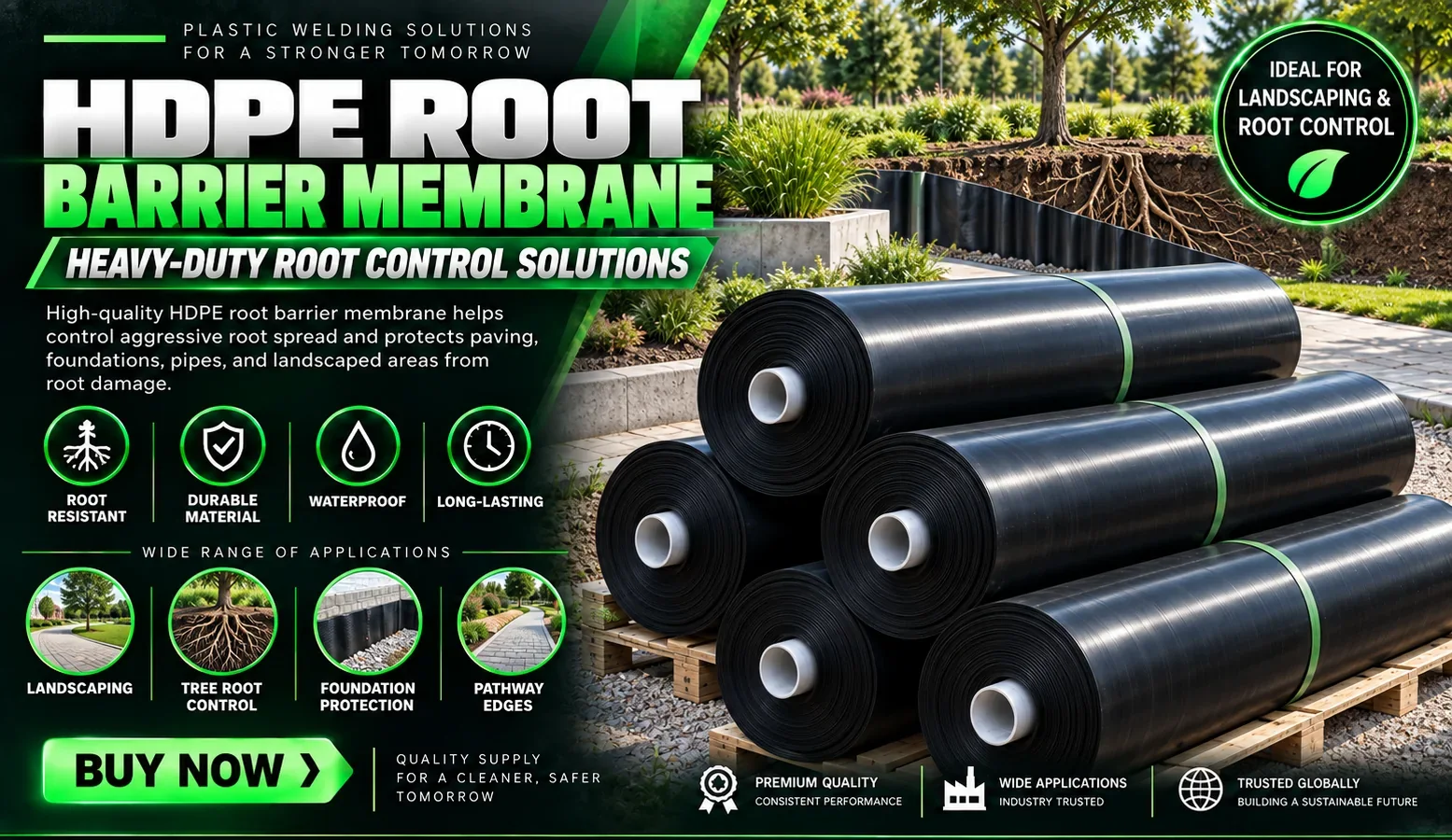
Root barrier product sheet
Downloadable and shareable. Right click to save, or send it from WhatsApp when a landscape contractor asks what we stock.
Root barrier against geomembrane liner
| Root barrier | HDPE geomembrane liner | |
|---|---|---|
| Thickness | 0.20 mm | 0.75 mm to 3.00 mm |
| Purpose | Deflect roots | Contain liquid |
| Orientation | Vertical, in a trench | Lining a basin floor and batters |
| Jointing | Overlapped, sometimes taped | Welded and tested to ASTM |
| Seam requirement | None | Peel and shear values by gauge |
| Equipment needed | Hand tools | Wedge welder, extruder, test kit |
A landscape contractor lining a water feature and installing root barrier on the same site needs both products. They are not interchangeable.
Frequently asked questions
What is a root barrier?
A root barrier is an impermeable membrane installed vertically in the ground to stop tree and shrub roots growing where they would cause damage. Roots do not push through polyethylene; they meet the sheet and are deflected sideways or downwards along it. The barrier is set between the planting and whatever needs protecting, typically a building foundation, a pavement, a kerb line, a service trench or a waterproofing layer beneath a podium deck.
What thickness of root barrier do I need?
We stock 0.20 mm HDPE root barrier, which suits landscaping work: planters, tree pits, median strips, kerb and pavement protection, and general amenity planting. It is the standard grade for the great majority of root barrier installations. Where the application is heavier, for example an aggressive species close to a structure, or a barrier that will be loaded during backfill, a thicker HDPE sheet from the geomembrane range can be specified instead. Ask if you are not sure which the design calls for.
How is root barrier joined?
Overlap rather than weld, in most installations. Standard practice is a generous overlap, commonly 300 mm or more, with the joint arranged so roots meeting it are deflected along the sheet rather than into the gap. Some specifications call for the overlap to be taped or mechanically fixed. At 0.20 mm the material is too thin for a wedge welder, which is built for structural liner and would burn through it. Where a continuous welded joint is genuinely required, a hot air welder at a low temperature setting is the tool, tested on offcuts first.
How deep should a root barrier be installed?
Depth is set by the species, the soil and what is being protected, so follow the landscape architect or arborist's detail. As general guidance, barriers are installed to a depth that puts them below the main lateral rooting zone, commonly in the range of 600 mm to 1000 mm for amenity planting, and deeper for large species. The top edge is normally brought to just below finished level, or slightly proud where surface rooting is a concern, so roots cannot simply grow over it.
Is root barrier the same as a damp proof membrane?
No, though they can look similar and both are polyethylene. A damp proof membrane resists moisture movement through a floor or wall. A root barrier is installed vertically to deflect root growth, and its job is mechanical rather than hydraulic. Using a thin general purpose polythene sheet as a root barrier is a common false economy, because it tears during backfill and degrades in the ground. Root barrier is carbon black stabilised HDPE for exactly that reason.
Everything here is part of the welding equipment we stock in Dubai for export.
Related pages
- HDPE geomembrane supplyThe structural liner range, from 0.75 mm to 3.00 mm, for containment rather than deflection.
- HDPE pond linerLiner for ponds, water features and landscape lakes on the same sites.
- Hot air welding machineThe only machine suited to joining material this thin, where a welded joint is required.
- Technical specificationsFull property table for the heavier HDPE grades.
Root barrier for a landscape project
Tell us the linear metres, the depth and the delivery point. We will quote the roll quantity and can ship it with a liner order.