Weldy booster EX3 extrusion welder
The Weldy extruder built for geomembrane. Longer barrel, 3.4 kg an hour, 6.9 kg, and three stars from Weldy for liner work against one for its EX2 stablemate. The machine to pair with a WGW 300 on a lining project.
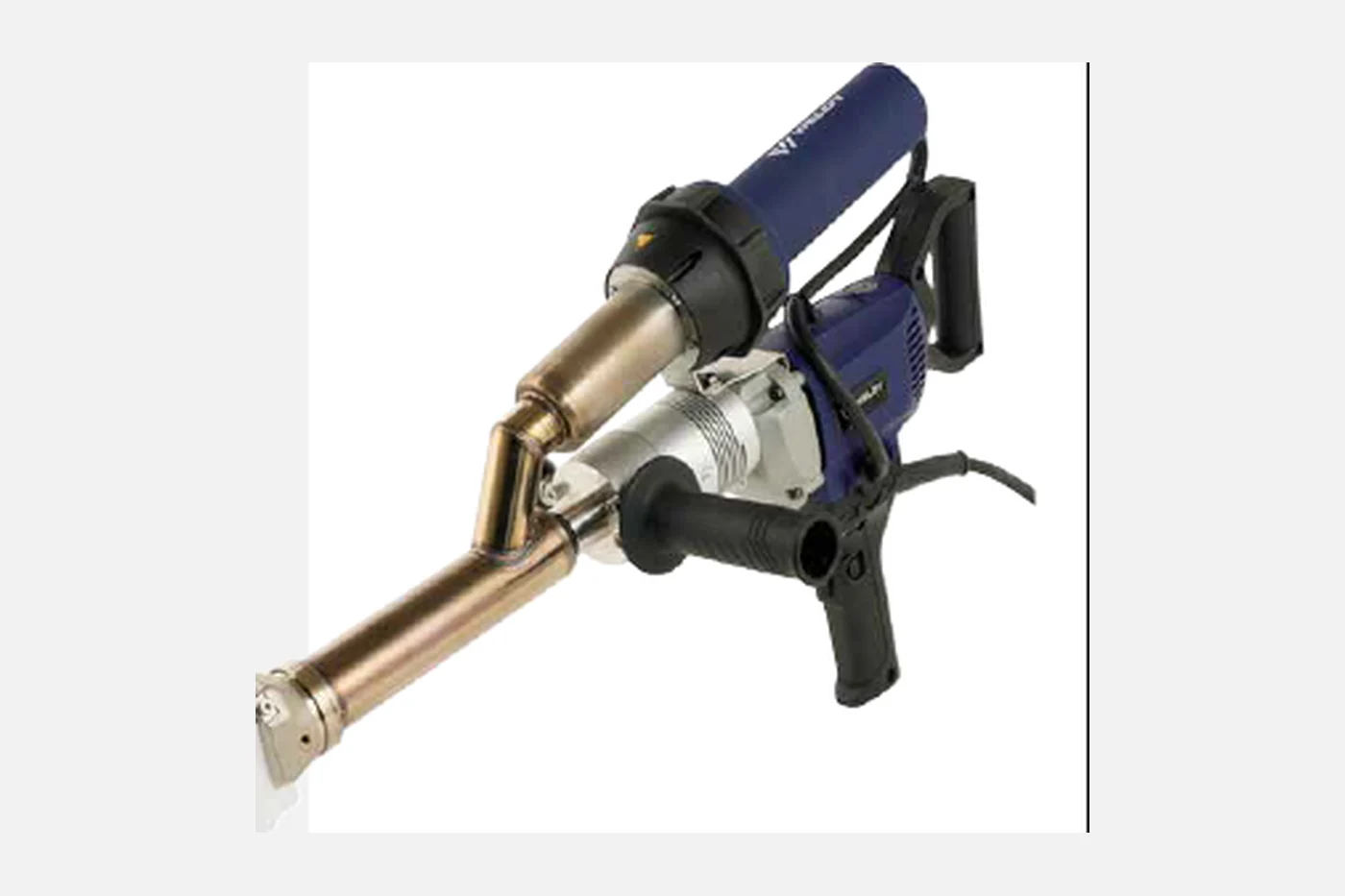
If you read one line in the Weldy catalogue before choosing an extruder, read the geomembrane row of the application matrix. The booster EX3 gets three stars. The EX2 gets one. Weldy built the EX3 for lining work, and the design choices show it.
The barrel is 630 mm against the EX2's 500 mm. That sounds like a detail until you spend a shift on a liner. A longer barrel puts the shoe further from your hands, so you weld standing rather than bent double, and posture is what determines whether an operator is still laying consistent beads at four in the afternoon.
The pairing that makes sense
A lining crew equipped with Weldy machines carries the WGW 300 for production seams and the EX3 for everything the wedge welder cannot reach: patches, pipe boots, cap strips, corners and detail at structures. Add the HT1600 for tacking and the crew has all three welding processes from one manufacturer, with parts and consumables that cross-reference to one catalogue.
What is in the kit
Article 146.917 ships in a transport case with the instruction manual, a T-handle hex socket wrench, a carbon brush for the drive motor, the UBL30/1.5 welding shoe kit, a spare heating element and a brass brush. The spare element and brush are the parts that stop an extruder, and Weldy put them in the box. The UBL30/1.5 shoe is an overlap profile for welding across a sheet edge, which is the geomembrane joint.
Materials
HDPE, LDPE, LLDPE and PP. All four are polyolefins and all four extrusion weld. PVC is not on the list and never is for extrusion welding; PVC is joined with hot air. Match the rod to the sheet resin, and for exposed liner use black carbon-stabilised rod so the repair does not age faster than the sheet around it.
Specification
Figures from the Weldy catalogue. Article 146.917 is the EU plug kit with transport case and shoe; 145.936 is the CN set.
| Parameter | Specification |
|---|---|
| Model | Weldy booster EX3 |
| Article numbers | 146.917 kit, EU plug; 145.936 CN set |
| Voltage | 230 V |
| Maximum power | 3,000 W |
| Welding wire | 3 mm or 4 mm |
| Materials | HDPE, LDPE, LLDPE, PP |
| Maximum output | 3.4 kg/hour |
| Dimensions, L × W × H | 630 × 140 × 380 mm |
| Weight | 6.9 kg |
| Protection class | II, double insulated |
| Welding shoe | UBL30/1.5 kit supplied |
| Handle | Ergonomic rotary handle |
| Extruder | High quality barrel extruder |
| Kit contents | Manual, transport case, T-handle hex socket wrench, drive motor carbon brush, UBL30/1.5 welding shoe kit, heating element, brass brush |
| Conformity | CE |
The EX3 ships with the UBL30/1.5 overlap shoe rather than the EX2's K8/10 fillet shoe. That tells you what each is for: UBL shoes lay a bead across an overlap, which is the geomembrane joint. Both kits include a spare heating element and carbon brush.
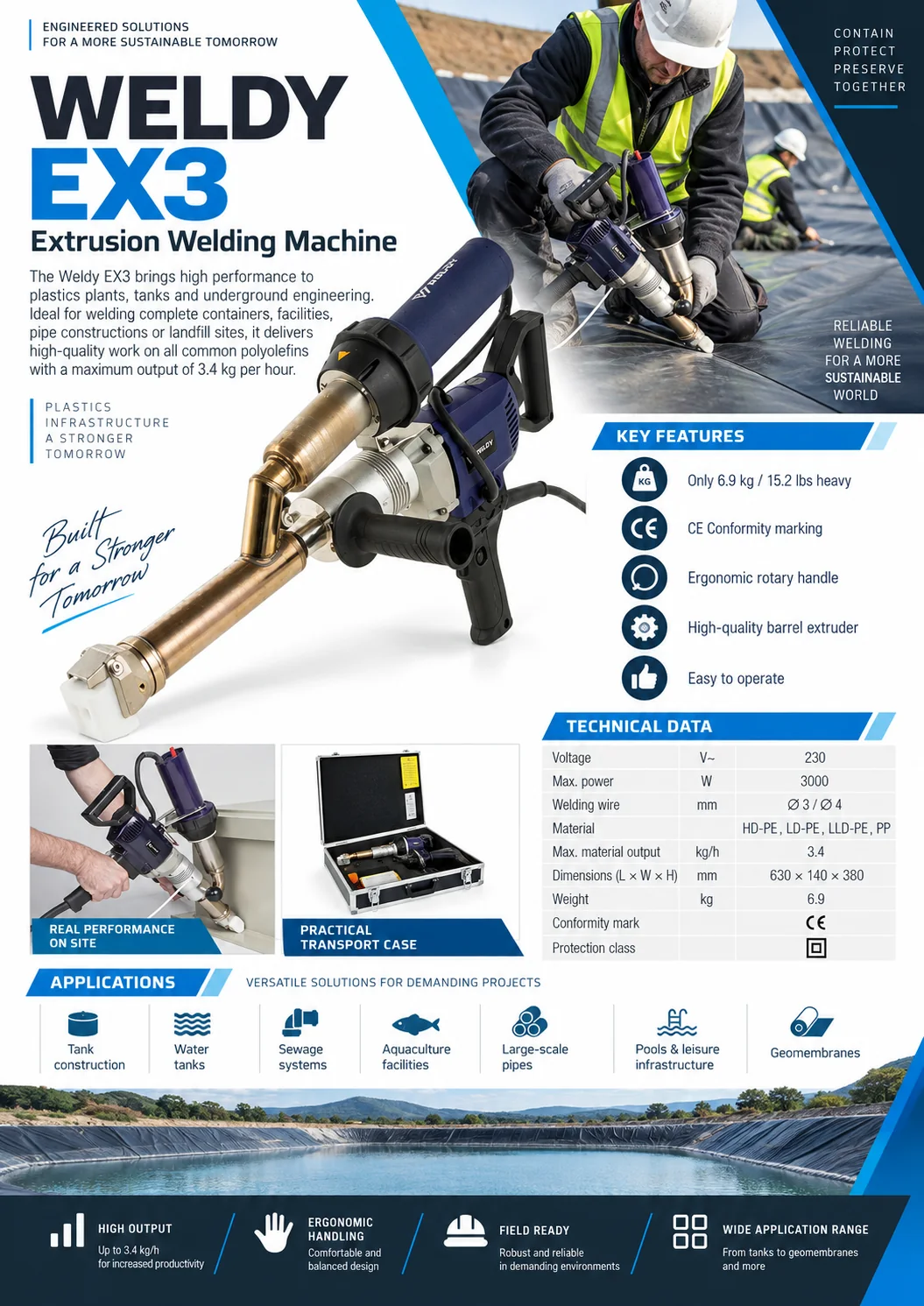
Weldy datasheet
The manufacturer's product sheet. Right click to save, or send it from WhatsApp when a customer asks for the Weldy specification.
Shoes are ordered to the joint, not the machine
Weldy list thirteen welding shoes for the booster range. Fillet shoes K8/10 and K15 for corner beads. V-weld shoes for butt joints in thick sheet. Overlap shoes UBL25, UBL30 and UBL35 for welding across a sheet edge at different widths. Corner shoes for inside and outside corners. The EX3 ships with UBL30/1.5. If your work needs another profile, say so at enquiry and it comes with the machine.
Frequently asked questions
Why is the EX3 the geomembrane extruder?
Three things. The longer 630 mm barrel puts the shoe further from your hands, which makes it comfortable to work standing up on a horizontal liner rather than crouching. The 3.4 kg an hour output lays a full bead at a walking pace. And it ships with the UBL30/1.5 overlap shoe, which is the profile for welding across a sheet edge. Weldy rate it three stars for geomembrane against one for the EX2.
How does the EX3 compare with the IZ-620?
The EX3 is the premium option: Weldy branded, 3.4 kg an hour, a 360 degree shoe, and a kit that includes a spare heating element and carbon brush. The IZ-620 is our own-brand extruder, 1.8 to 3.6 kg an hour, taking 3.0 to 4.5 mm rod, and it costs less. For a crew that wants a European brand name on the machine or a specification that requires one, the EX3. For a crew buying on price for the same work, the IZ-620 does the job.
What rod does the EX3 use?
Three or four millimetre round rod in HDPE, LDPE, LLDPE or PP. For geomembrane the usual choice is 4 mm black HDPE, carbon black stabilised, which is what we stock as welding rod. Weldy list their own 4 mm HDPE rod, article 115.366, in 5 kg coils.
What does 3.4 kg an hour mean for a lining crew?
It is the maximum deposition rate, and it determines how fast you can lay a full fillet bead. At 3.4 kg an hour on 4 mm rod, an operator can weld continuous cap strips and pipe boots at a steady pace rather than waiting for the machine. For patch work the output matters less; for a project with hundreds of metres of extrusion detail it is the difference between one extruder and two.
Is the EX3 heavy?
At 6.9 kg it is half a kilogram heavier than the EX2 and Weldy make a point of that figure in the catalogue. Balanced across the rotary handle and the barrel it is manageable for a full shift. What tires operators is not weight but posture, and the long barrel improves posture on horizontal work considerably.
For the wider context, see our geomembrane welding machine dealer page.
Related pages
Get a booster EX3 quoted
Send the liner thickness and the destination. We will quote the EX3 kit delivered, with matched rod and a WGW 300 if you need both.