HDPE geomembrane supplier
Virgin resin HDPE liner from 0.75 mm to 3.00 mm with mill certificates, supplied from Dubai with the welding machines, rod and test equipment to install and prove it.
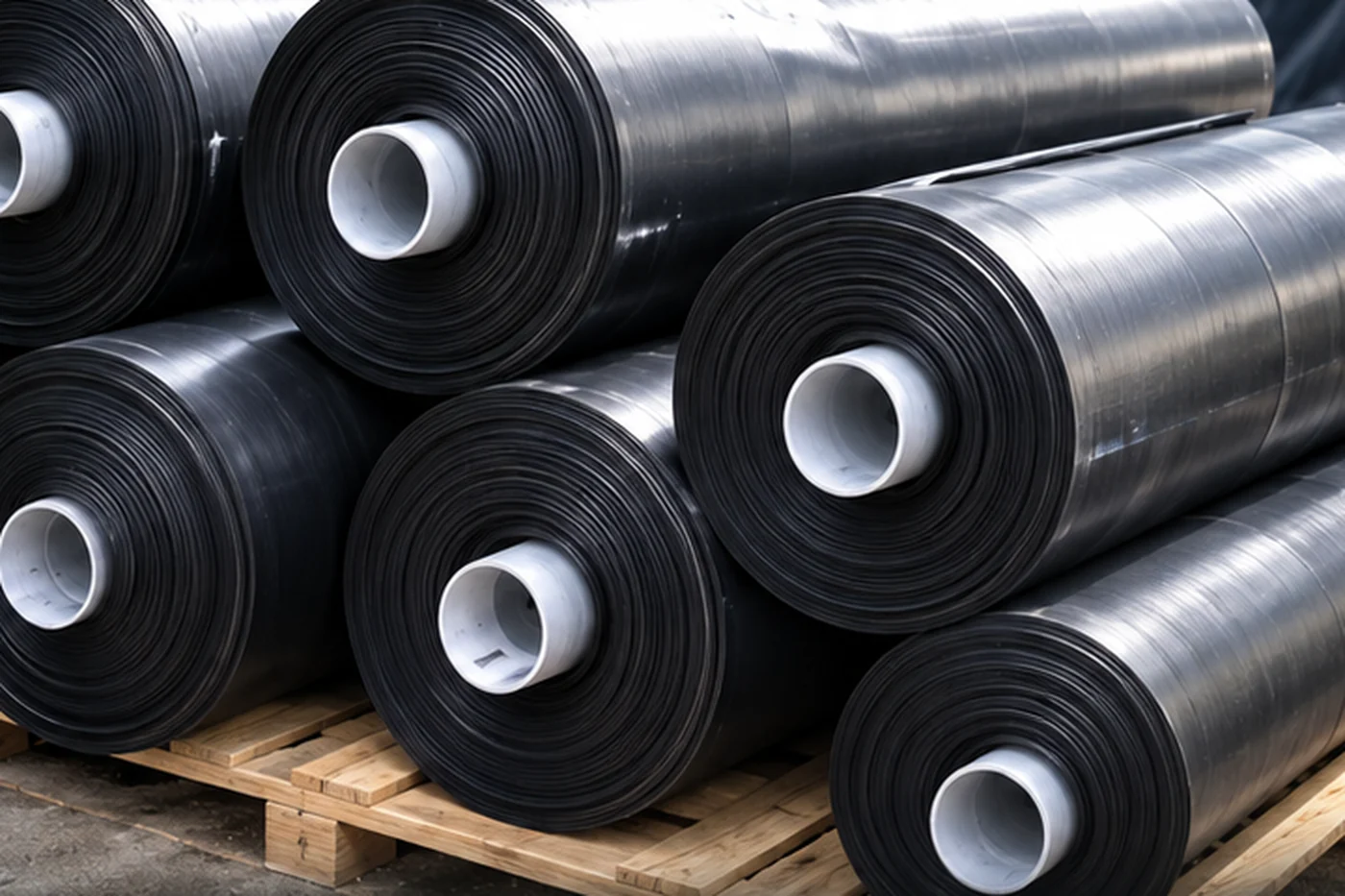
We supply HDPE geomembrane liner as part of a package with the equipment to weld it. That is a deliberate position rather than a sideline. Most seam failures on lining projects trace back to a mismatch somewhere between the sheet, the filler rod and the machine settings, and the surest way to remove that risk is for one supplier to be responsible for all three.
What we supply
The material is HDPE geomembrane produced from virgin high density polyethylene resin, stabilised with 2.0 to 3.0 percent carbon black, in six nominal thicknesses from 0.75 mm to 3.00 mm. It is available double side smooth as standard, and single or double side textured where the design needs interface friction on slopes.
Manufacture is to an ISO 9001 quality system and the property set follows the GRI GM13 framework that most specifications reference. Testing during production covers thickness, density, tensile properties, tear and puncture resistance, stress crack resistance, carbon black content and dispersion, oxidative induction time and seam strength. The frequencies for each are in the specification table.
Geomembrane, liner, or sheet?
Buyers use the words interchangeably and so do suppliers, which makes comparing quotations harder than it should be. In practice an HDPE geomembrane, an HDPE liner and HDPE liner sheet all describe the same product: the impermeable polyethylene sheet welded into a containment barrier. Geomembrane is the engineering term and the one specifications use. Liner is the term contractors use on site. Sheet usually refers to the material as supplied, before it is installed.
What is worth checking in any quotation is not the word but the numbers behind it: the resin, the nominal thickness, whether that thickness is a minimum average value, and whether the sheet is smooth or textured. Two quotations for 1.50 mm liner can be for materially different products.
Who this suits
Buyers we are set up to serve well:
- Contractors mobilising to a new market. One consignment with sheet, machines, rod and test equipment, one supplier, one set of export documents.
- Projects with a defined specification. Send the clauses and we will confirm whether the material meets them before you order rather than after.
- Buyers in Africa and South Asia. Dubai is closer than Europe and considerably easier to deal with than sourcing directly from an unfamiliar factory.
- Repeat purchasers of consumables. Once the sheet grade is established, reordering matched rod is straightforward.
How it ships
Liner travels as rolls on a flatbed or in containers depending on quantity and destination. A 1.50 mm roll at 7 m wide and 140 m long covers 980 square metres and is heavy, so quantities of any size move by sea. Machines and rod consolidate into the same shipment. Transit times, ports and documentation by country are set out on the export page.
Standard roll sizes
| Thickness | Roll width | Roll length | Roll area | Typical use |
|---|---|---|---|---|
| 0.75 mm | 7 m | 280 m | 1960 m² | Farm ponds, water pans, aquaculture, temporary storage |
| 1.00 mm | 7 m | 210 m | 1470 m² | Irrigation reservoirs, effluent lagoons, canal lining |
| 1.50 mm | 7 m | 140 m | 980 m² | Landfill cells, capping, industrial containment, bunds |
| 2.00 mm | 7 m | 105 m | 735 m² | Leach pads, tailings, heavy duty containment |
| 2.50 mm | 7 m | 84 m | 588 m² | Mining and severe chemical duty |
| 3.00 mm | 7 m | 70 m | 490 m² | Specialist heavy gauge applications |
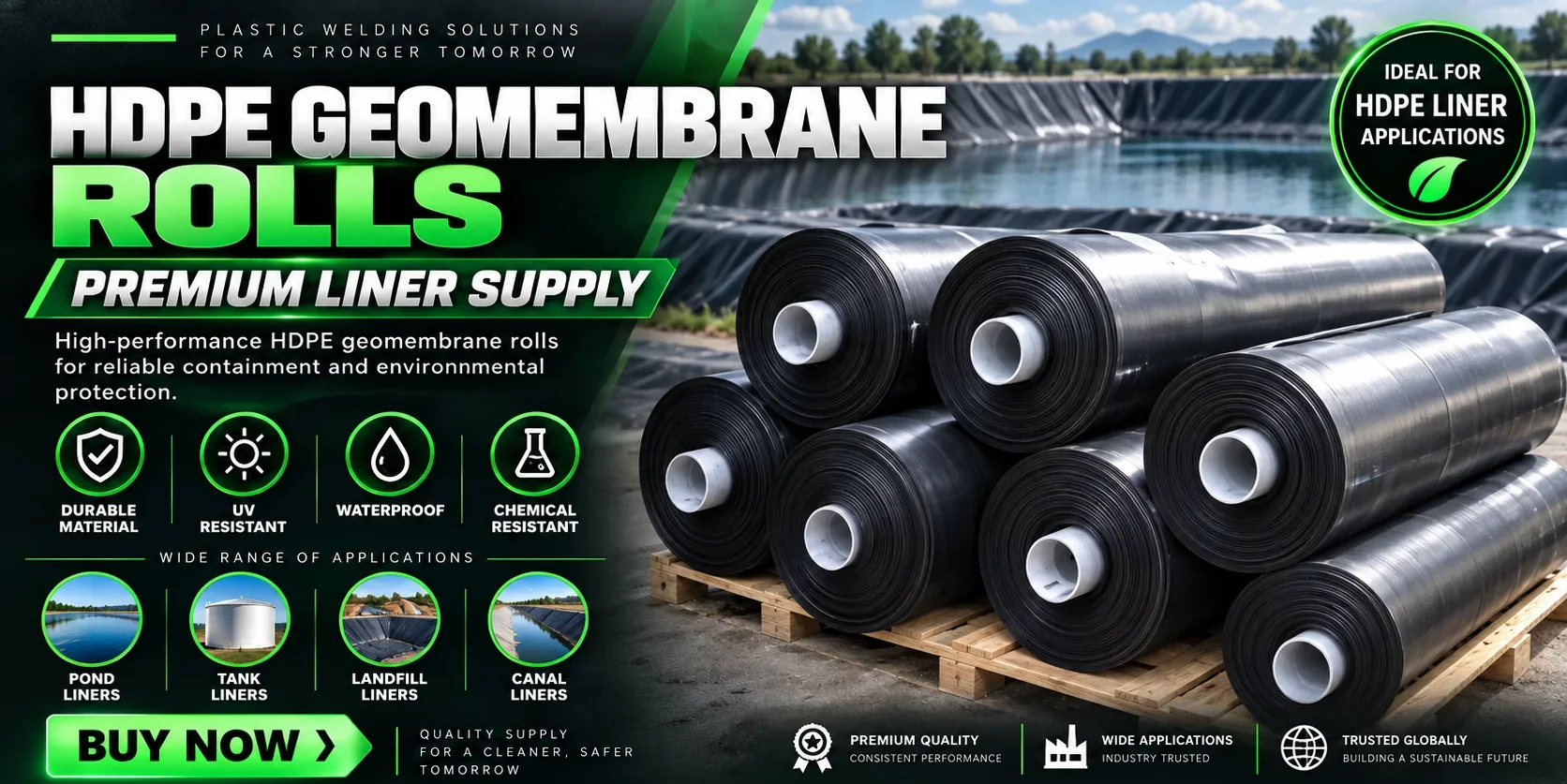
HDPE geomembrane product sheet
Downloadable and shareable. Right click to save, or send it from WhatsApp when a customer asks what the range covers.
Frequently asked questions
What is HDPE geomembrane?
HDPE geomembrane is an impermeable sheet manufactured from high density polyethylene resin with carbon black added for ultraviolet stability, along with antioxidants and thermal stabilisers. It is produced in rolls, delivered to site and welded into a continuous barrier. Its properties are what make it the default lining material worldwide: extremely low permeability, resistance to a wide range of chemicals, and a service life measured in decades when correctly installed and covered. The minimum average density is 0.940 g/cc, which is what the H in HDPE refers to.
What thickness of geomembrane do I need?
It is set by the design engineer, not by preference, and depends on hydraulic head, subgrade condition, loading, chemical exposure and required service life. As a broad orientation, 0.75 mm and 1.00 mm suit farm ponds, water pans and irrigation storage. Thicknesses of 1.50 mm are common for landfill cells, canals and industrial containment. Mining leach pads and tailings facilities generally call for 2.00 mm and above. Thicker sheet resists puncture better but is heavier to handle and slower to weld, so oversizing has real costs. Full properties for each gauge are in the technical specification.
Do you supply mill certificates?
Yes. Every consignment is accompanied by manufacturer quality control certificates covering the properties tested during production, referenced to the roll numbers supplied. This matters for any project under construction quality assurance, because the CQA consultant will ask for them before the liner is accepted onto site. Where a project requires conformance testing by an independent laboratory in addition, we can support sampling from the delivered rolls.
What is the difference between HDPE and LLDPE geomembrane?
HDPE is stiffer, stronger and more chemically resistant, and is the standard choice for most containment. LLDPE is more flexible and has far higher elongation, so it conforms better to irregular subgrades and tolerates differential settlement, which makes it preferred for landfill capping and for sites expected to move. The trade-off is lower tensile strength and reduced chemical resistance. Welding equipment is the same for both, but LLDPE runs at different parameters and requires LLDPE welding rod rather than HDPE rod for extrusion work.
How long does an HDPE liner last?
Service life depends overwhelmingly on exposure. Buried or covered liner, protected from ultraviolet light and temperature extremes, is generally expected to last many decades and is commonly designed on a service life well beyond fifty years. Liner left permanently exposed in a hot climate ages far faster, because ultraviolet exposure and heat gradually deplete the antioxidant package that protects the polymer. The UV resistance figure in our specification, 50 percent HP-OIT retained after 1600 hours of accelerated weathering to GRI GM11, is the measure of that protection. Covering exposed liner where the design allows is the single largest factor in extending its life.
Do you install geomembrane, or only supply it?
We supply. We are an equipment and material supplier, not a lining contractor, and we do not carry out installation. That distinction matters when you are comparing quotations, because an installed rate per square metre and a supply-only rate are not comparable figures. A supply-only price covers the sheet delivered; an installed price also covers labour, welding plant, testing, quality records and programme risk. If you are looking for a supply and install package rather than material, say so in your enquiry and we will tell you plainly that we are not the right supplier rather than waste your time.
Which countries do you supply geomembrane to?
All six GCC states and our listed African markets, shipped from Dubai. Liner moves by sea because of its weight, and consolidates readily with a welding machine order into one consignment and one set of customs documents. Transit times and entry ports by country are on the export page. For destinations beyond that list, send the requirement and we will quote if we can serve it properly.
Can you ship geomembrane and welding machines together?
Yes, and it is usually the sensible arrangement. Liner rolls occupy a container and machines are small by comparison, so consolidating removes a separate air freight charge and gives one set of customs documents rather than two. It also means the welding rod is guaranteed to match the sheet, because both come from the same order. See export and shipping for transit times to your country.
Everything above ships from the same stock as the rest of our geomembrane welding machine range.
Related pages
- Technical specificationsEvery tested property across all six gauges, with methods and frequencies.
- Welding machinesWedge, extrusion and hot air equipment for joining this material.
- Welding rodFiller matched to the sheet resin, ordered on the same consignment.
- Export and shippingPorts, transit times and documents for buyers outside the Emirates.
Order liner and plant on one consignment
One supplier behind the sheet, the rod and the machine removes the compatibility risk that causes most seam failures.