Weldy HT1600 hot air gun
The Weldy hot air hand tool. 1600 W, adjustable from 40 to 700 degrees, 240 litres of air a minute, a ceramic heating element, and 1.0 kg in the hand. Sold bare or in three kits, and the tool Weldy pair with their own extruders and wedge welder.
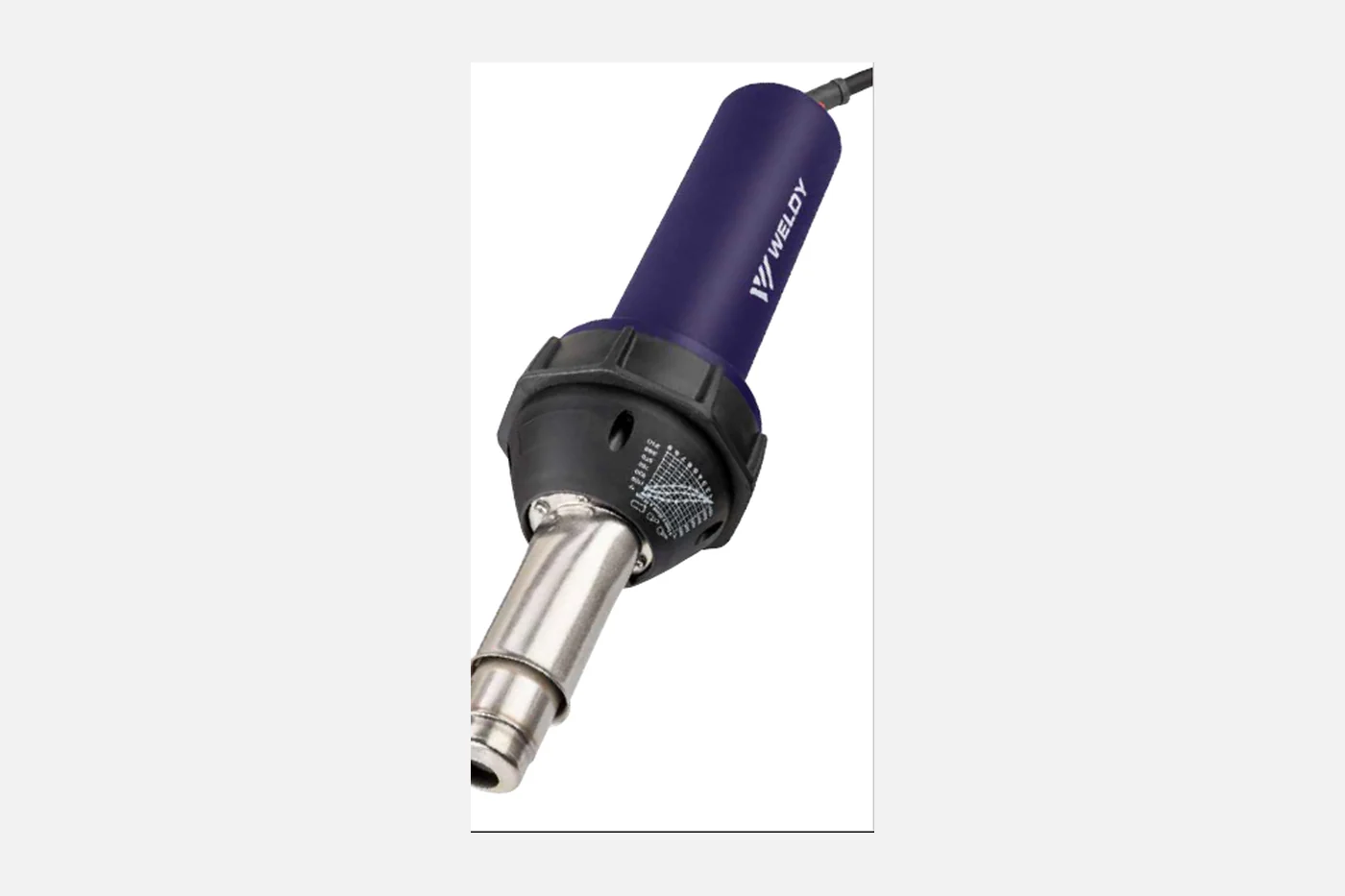
A hot air gun is the tool a lining crew uses most and thinks about least. It tacks panels before the wedge welder passes, preheats for extrusion work, welds PVC and coated fabric outright, and gets picked up fifty times a day. The HT1600 is Weldy's answer, and it is the gun they pair with the WGW 300 and the booster EX3.
What sets it apart
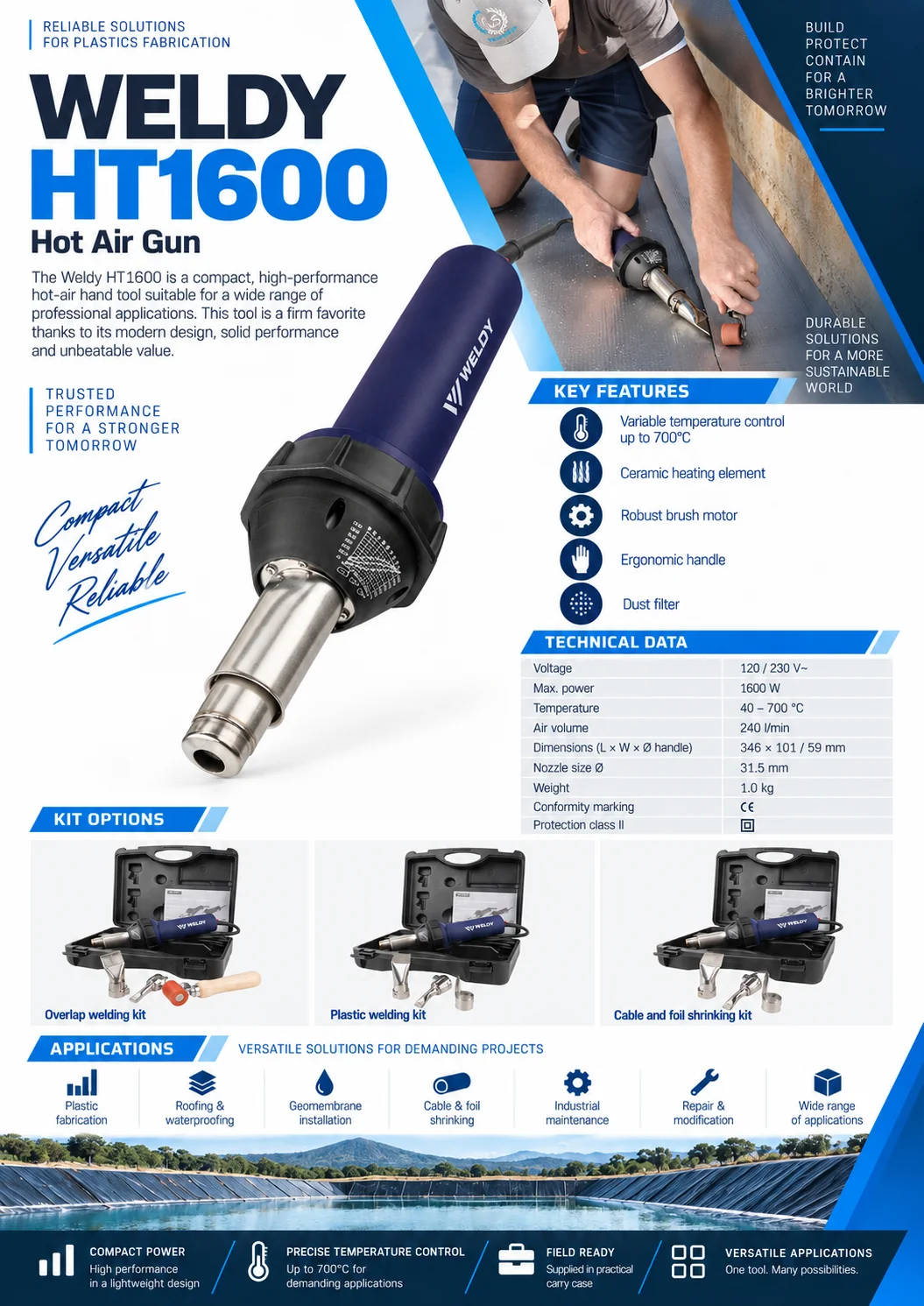
Three figures. The temperature range runs to 700 degrees, which is higher than most guns in this class and gives headroom for polyethylene tacking without running the element at its limit. The air volume is 240 litres a minute, which is what makes a gun weld rather than merely heat. And the heating element is ceramic, which holds up better to thermal cycling than a bare coil.
It weighs a kilogram. That is what an operator holds at arm's length for a shift, and it is the reason the HT1600 is comfortable where heavier guns are not.
Bare tool or kit
The bare tool ships with a set of replacement carbon brushes and the manual. Three kits add nozzles in a plastic case, each configured for a different job.
Specification
Figures from the Weldy catalogue. Four article numbers cover the plug variants; the EU plug tool is 120.881.
| Parameter | Specification |
|---|---|
| Model | Weldy HT1600 |
| Article numbers | 120.881 EU plug; 126.732 UK plug; 148.003 CN plug; 123.898 US, 120 V |
| Voltage | 230 V, or 120 V variant |
| Maximum power | 1,600 W |
| Temperature | 40°C to 700°C, variable |
| Air volume | 240 L/min |
| Heating element | Ceramic |
| Motor | Brush, robust |
| Dust filter | Fitted |
| Dimensions, L × W | 346 × 101 mm; handle 59 mm diameter |
| Nozzle seat | 31.5 mm |
| Weight | 1.0 kg |
| Protection class | II, double insulated |
| Delivery contents, bare tool | Hand tool, one set of replacement carbon brushes, instruction manual |
| Conformity | CE |
Even the bare tool ships with a set of replacement carbon brushes. The 700 degree ceiling is higher than most guns in this class and matters for HDPE tacking, which needs 450 to 600 degrees at the nozzle in Gulf conditions.
Weldy datasheet
The manufacturer's product sheet. Right click to save, or send it from WhatsApp when a customer asks for the Weldy specification.
| Item | Plastic welding kit | Overlap welding kit | Shrinking kit |
|---|---|---|---|
| Tubular nozzle, 5 mm | Yes | — | — |
| Speed welding nozzle, 4 mm | Yes | — | — |
| Wide slot nozzle, 40 mm | — | Yes | Yes |
| Wide slot nozzle, 20 mm | — | Yes | Yes |
| Pressure roller, 40 mm silicone | — | Yes | — |
| Spoon reflector | — | — | Yes |
| Carbon brushes for motor | Yes | Yes | Yes |
| Plastic case | Yes | Yes | Yes |
| Best for | Rod welding, fabrication | Liner tacking, PVC and fabric seams | Cable and foil shrinking |
For geomembrane work, order the overlap welding kit. The wide slot nozzles and the roller are what tacking a sheet lap uses.
Against the IZ-1600
Our own-brand IZ-1600 is the same power and also a brush motor, at a lower price. The HT1600 runs 80 degrees hotter, moves a third more air, and has a ceramic element and dust filter. For a gun that is used occasionally, the IZ-1600. For one that runs all day, the HT1600.
Frequently asked questions
What are the three HT1600 kits?
The plastic welding kit includes the 5 mm tubular nozzle, the 4 mm speed welding nozzle and a plastic case. The overlap welding kit includes the 40 mm and 20 mm wide slot nozzles, a 40 mm silicone pressure roller and the case. The cable and foil shrinking kit includes the wide slot nozzles, a spoon reflector and the case. All three include carbon brushes for the motor. For geomembrane tacking the overlap kit is the right one, because the wide slot nozzles and roller are what you use on a sheet lap.
How does the HT1600 compare with the IZ-1600?
Same power at 1600 W, and both use a brush motor. The Weldy runs hotter, 700 degrees against 620, and moves more air, 240 litres a minute against 180. It has a ceramic heating element and a dust filter. The IZ-1600 is 50 grams heavier and costs less. For occasional tacking the IZ-1600 is fine. For a gun that runs all day, or for PVC fabrication where the extra airflow shows, the HT1600 earns its price.
Why does the temperature range go to 700 degrees?
Because polyethylene needs it. PVC and coated fabric weld between 350 and 500 degrees, but HDPE tacking on a hot liner in direct sun needs 450 to 600 at the nozzle, and having headroom above that means the element is not running flat out. A gun with a 700 degree ceiling running at 550 lasts longer than a gun with a 600 degree ceiling running at 550.
Which plug variant do I need?
It depends on the destination. The EU plug tool, article 120.881, suits the Gulf and most of Africa. The UK plug variant, 126.732, suits markets on the British standard. The 120 V US variant, 123.898, is for 110 to 120 V supplies. Tell us the country and we supply the right one; a plug adaptor on a 1600 W tool is not a good idea.
What nozzles fit the HT1600?
Anything with a 31.5 mm nozzle seat, which is the Weldy standard. The catalogue lists the 5 mm tubular nozzle, the 4 mm speed welding nozzle, 20 mm and 40 mm wide slot nozzles, and a spoon reflector for shrinking. A 40 mm silicone pressure roller is the usual partner for the wide slot nozzles. We hold nozzles and brushes in Dubai.
The full equipment list sits on our geomembrane welding equipment page.
Related pages
Get an HT1600 quoted
Tell us the material and the job. We will quote the bare tool or the right kit, with the plug variant for your destination.