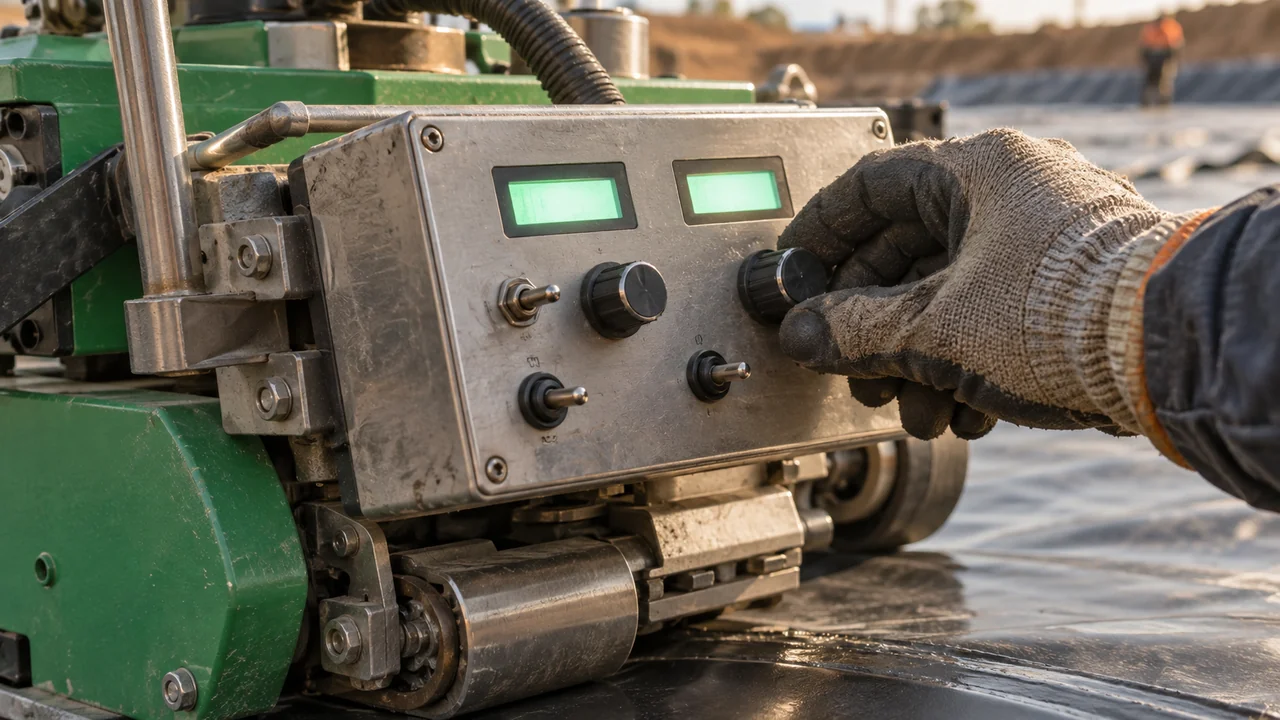
Heat input, not temperature
The variable that determines whether a seam fuses is how much heat enters the sheet, and that is a product of two things: how hot the wedge is, and how long the material spends against it. Raise the temperature or slow the machine down and you increase heat input. Either can fix a cold weld, and either can cause an overheated one.
This is why machines have digital control of both and why a single number is never the answer. Two crews welding identical liner can run different settings and both be right, because one is working at 08:00 in February and the other at 14:00 in July.
Starting parameters for hot wedge welding
Use these as a first setting for a trial weld, then adjust on the evidence of peel coupons. In Gulf summer conditions the lower end of each band is usually correct, because the sheet is already hot before the machine touches it.
| Thickness | Wedge temperature | Travel speed |
|---|---|---|
| 0.75 mm | 330-370°C | 2.5-4.0 m/min |
| 1.00 mm | 340-380°C | 2.0-3.5 m/min |
| 1.50 mm | 360-400°C | 1.5-2.5 m/min |
| 2.00 mm | 370-410°C | 1.2-2.0 m/min |
| 2.50 mm | 380-420°C | 1.0-1.6 m/min |
| 3.00 mm | 390-430°C | 0.8-1.4 m/min |
What shifts the setting
- Ambient and sheet temperature. Black liner in direct sun reaches 60°C or more. It needs less added heat than the same sheet at 20°C.
- Wind. Moving air strips heat from the seam as it forms. A windy afternoon needs more heat input than a still morning at the same air temperature.
- Textured material. Asperities have to be melted through before the sheet beneath fuses, so textured liner needs more heat input than smooth sheet of the same gauge.
- LLDPE instead of HDPE. Different resin, different window. Do not carry HDPE settings across.
- A tired heating element. A failing element holds its set point at idle and drops under load. The display lies, and the seam is cold. Keep a spare element on site.
Extrusion welding settings
Two temperatures matter on an extruder and they do different jobs. Extrudate temperature, typically 210°C to 240°C for HDPE, determines the state of the material being laid down. Preheat air temperature, up to around 450°C, determines whether the parent sheet is soft enough to fuse with it.
Of the two, preheat causes more failures. Settings also depend on the rod grade you are feeding. If the sheet is not softened before the bead lands, the extrudate cools onto cold plastic, forms a mechanical bond rather than a fusion bond, and peels cleanly under test. Travel speed governs how long preheat is applied, so speed and air temperature are set together.
Trial welds are the actual method
Every table of settings, including this one, is a starting point. The method that works is a trial weld at the start of each shift and after any significant change: same liner, same machine, same settings, then cut coupons and pull them in a field tensiometer for peel and shear. Only when coupons pass do production seams begin.
Watch the failure mode, not just the number
A coupon should tear in the parent sheet away from the weld. If it separates cleanly at the interface between the two sheets, the weld failed regardless of the load recorded. That is the signature of a cold seam, and the fix is more heat input.
Frequently asked questions
What temperature should I weld HDPE geomembrane at?
For hot wedge welding, generally between 330°C and 430°C depending on sheet thickness, with thicker material needing more. But temperature alone does not answer the question, because travel speed determines how long that heat is applied. Establish the pairing with a trial weld in the day's actual conditions and confirm it with peel coupons.
Why did settings that worked yesterday fail today?
Almost always a change in conditions. Ambient temperature, direct sun on the liner, wind, or a switch to a different roll or gauge. Occasionally it is a machine problem, most often a heating element beginning to fail, which shows as a set point held at idle and lost under load. Either way the answer is a fresh trial weld rather than pressing on with yesterday's numbers.
Everything above ships from the same stock as the rest of our geomembrane welding machine range.