IZ-900 wedge welding machine for geomembrane seams
The IZ-900 is the production machine on any lining project. It makes the long primary seams, faster than any other process, and it is the only method that produces a testable dual track weld. CE marked, 1.0 mm to 3.0 mm, 13 kg.
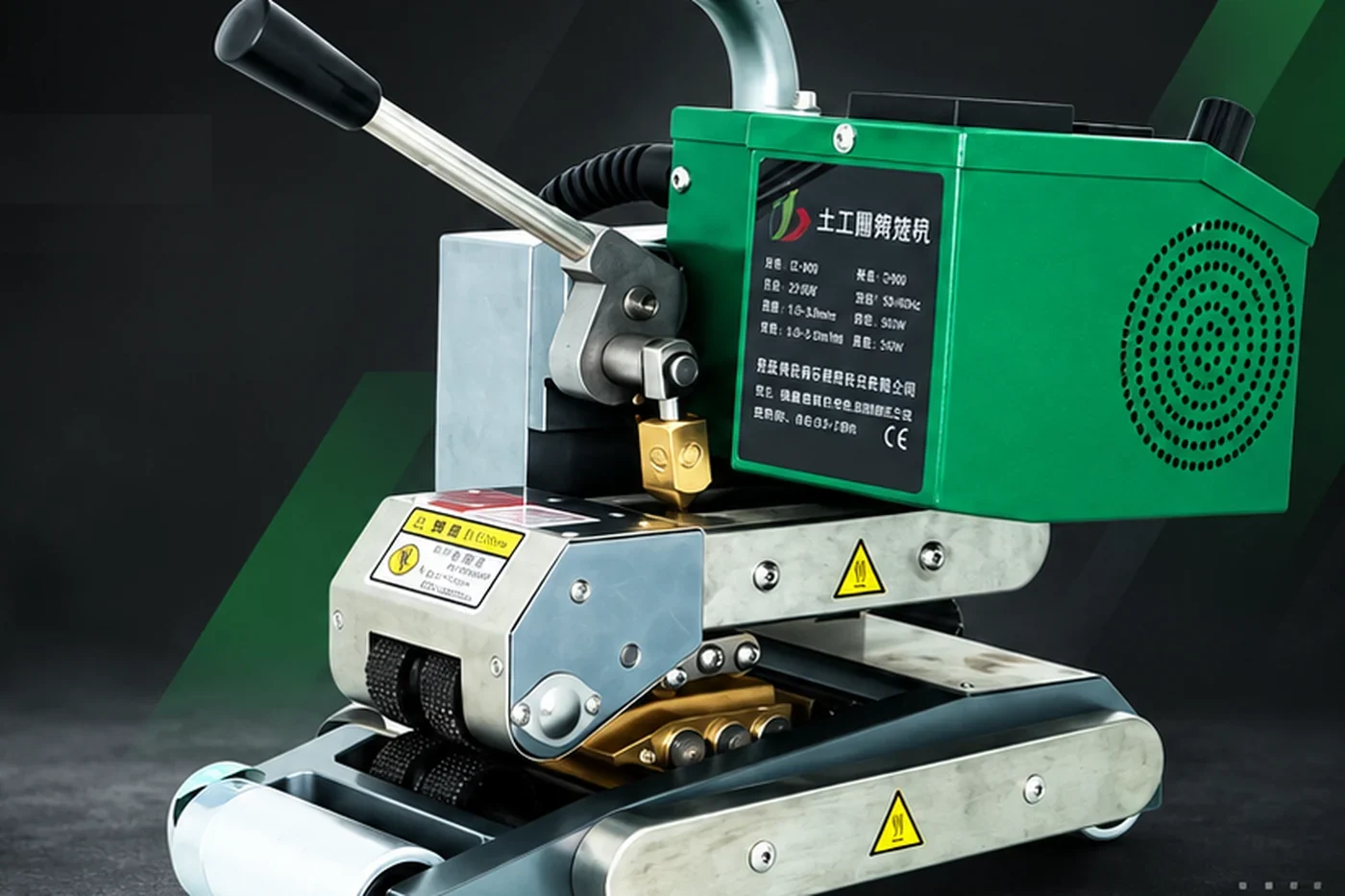
An automatic hot wedge welder does one job extremely well: it turns two overlapping sheets of liner into a continuous, watertight, testable seam at walking pace. On a reservoir, a canal or a landfill cell, that seam runs for hundreds of metres and it has to be identical along its whole length. No hand held process can do that.
The mechanism is simple enough to explain in three parts. A heated metal wedge slides into the overlap and melts the inner face of both sheets. Two driven rollers immediately behind the wedge squeeze the softened surfaces together at a set pressure. A motor drives those rollers, so the machine climbs along the seam by itself while the operator guides it and watches the alignment. Heat, pressure and speed are the only three variables, and all three are set on the control panel.
Why the specification asks for wedge welding
Consistency is the first reason. A wedge weld is made by a machine holding fixed parameters, so the thousandth metre is made under the same conditions as the first. An extrusion weld is made by a person, and varies with their fatigue, their angle and their pace.
Testability is the second and more important reason. A dual track wedge leaves an unwelded channel between its two weld tracks. Seal one end, pressurise the other with a needle and a hand pump, and the gauge tells you whether the entire seam holds. That is a non-destructive test of every metre, completed in minutes, with a number that goes in the quality records. No other field process offers it. Engineers write dual track wedge welding into specifications precisely so that the seam can be proven rather than inspected by eye.
Speed is third. On a large water reservoir the wedge welder will produce eighty to ninety percent of the total seam length, leaving hand work only where the geometry forces it.
Setting the machine for the liner
The single most common cause of failed peel tests is running yesterday's settings today. Heat input into the sheet is a function of wedge temperature and how long the material spends against the wedge, which is travel speed. Change the sheet thickness and both need revisiting. Change the weather and they need revisiting again.
Working practice on a properly run site is a trial weld at the start of each shift and after any significant change in conditions: same liner, same machine, same settings, then cut coupons and pull them in a field tensiometer to peel and shear. Only when the coupons pass do production seams start. The table below gives sensible starting points, not final answers.
Specification
These are the manufacturer figures for the IZ-900, the wedge welder we stock. They are the machine's actual rated values, not a generic category range.
| Parameter | Specification |
|---|---|
| Model | IZ-900 |
| Welding process | Hot wedge, dual track with central test channel |
| Materials | HDPE, LLDPE, PVC geomembrane |
| Material thickness | 1.0 mm to 3.0 mm, single layer |
| Heating temperature | 50°C to 550°C |
| Welding speed | 1 to 7 m/min, variable |
| Welding pressure | 100 to 1000 N, adjustable |
| Weld seam width | 2 x 16 mm welds with a 12 mm test cavity |
| Overlap width | 120 mm |
| Weld strength | Over 95% of base material in shear |
| Voltage | 220 V |
| Frequency | 50/60 Hz |
| Power | 2,100 W |
| Display | Dual digital display, temperature and speed |
| Weight | 13.0 kg |
| Certification | CE |
| Warranty | 1 year on motors and circuit boards |
Temperature and speed are set together, not independently. Thicker sheet needs more heat input, which means either a higher wedge temperature or a slower travel speed, and the 50 to 550°C range gives room for both. Trial welds at the start of each shift establish the correct pairing for the day's conditions. Note the 1.0 mm lower limit: for 0.75 mm liner we supply the Weldy WGW 300, rated from 0.8 mm.
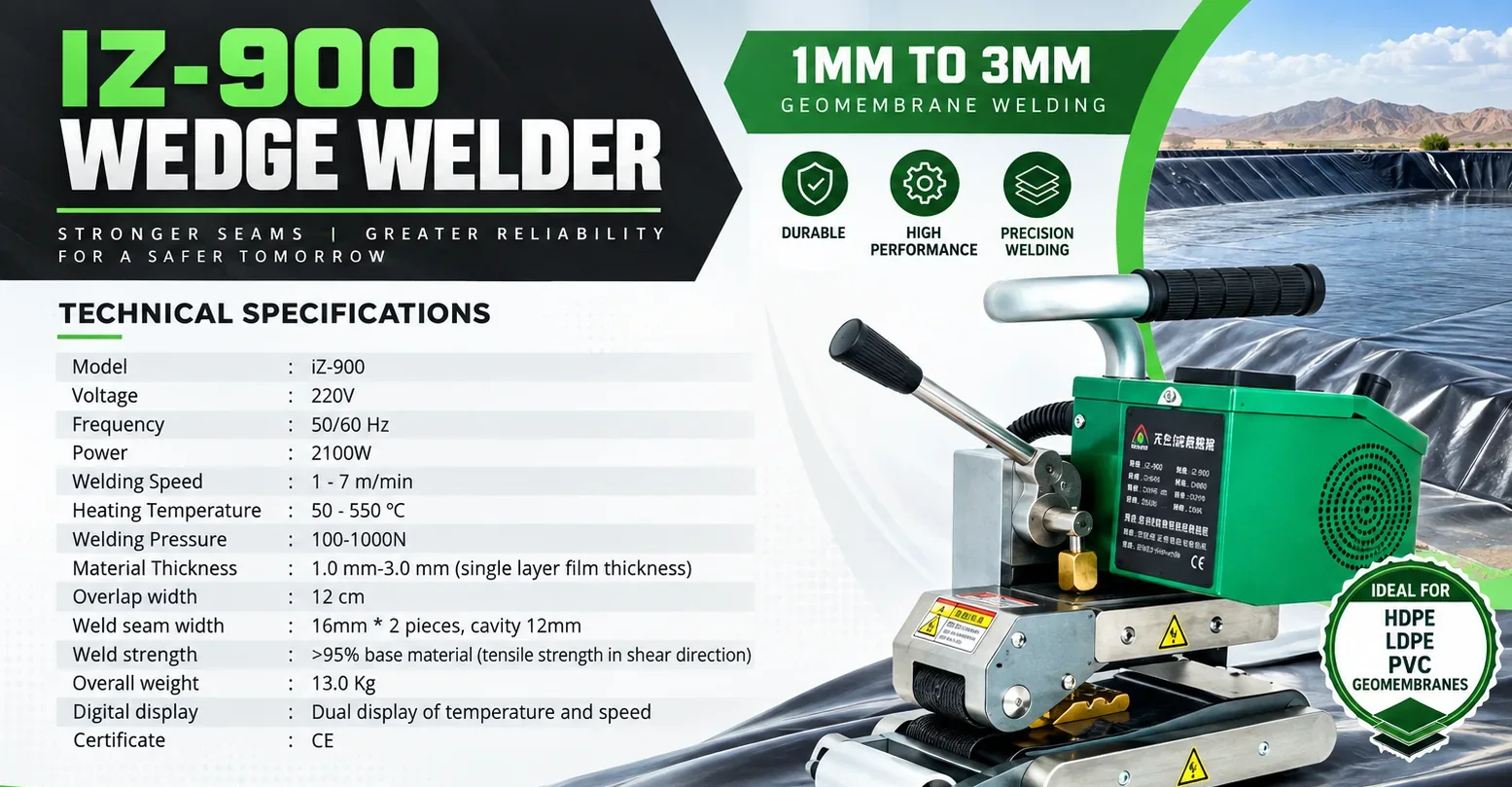
IZ-900 product sheets
Both sheets below are downloadable and shareable. Right click to save, or send them straight from WhatsApp when a customer asks for specifications.
Starting parameters by liner thickness
Use these as a first setting for the trial weld, then adjust on the evidence of the peel coupons. Ambient temperature in the Gulf frequently justifies settings at the lower end of each band.
| Liner thickness | Wedge temperature | Travel speed | Typical application |
|---|---|---|---|
| 0.75 mm | 330-370°C | 2.5-4.0 m/min | Farm ponds and water pans. Below the IZ-900's 1.0 mm rated minimum — ask us about a machine for thinner sheet. |
| 1.00 mm | 340-380°C | 2.0-3.5 m/min | Irrigation reservoirs, effluent lagoons |
| 1.50 mm | 360-400°C | 1.5-2.5 m/min | Landfill cells, canal lining, bunds |
| 2.00 mm | 370-410°C | 1.2-2.0 m/min | Leach pads, tailings, heavy containment |
| 2.50 mm | 380-420°C | 1.0-1.6 m/min | Mining and severe duty containment |
| 3.00 mm | 390-430°C | 0.8-1.4 m/min | Specialist heavy gauge applications |
Seam strength requirements for each gauge are set out in the geomembrane technical specifications, tested to ASTM D6392.
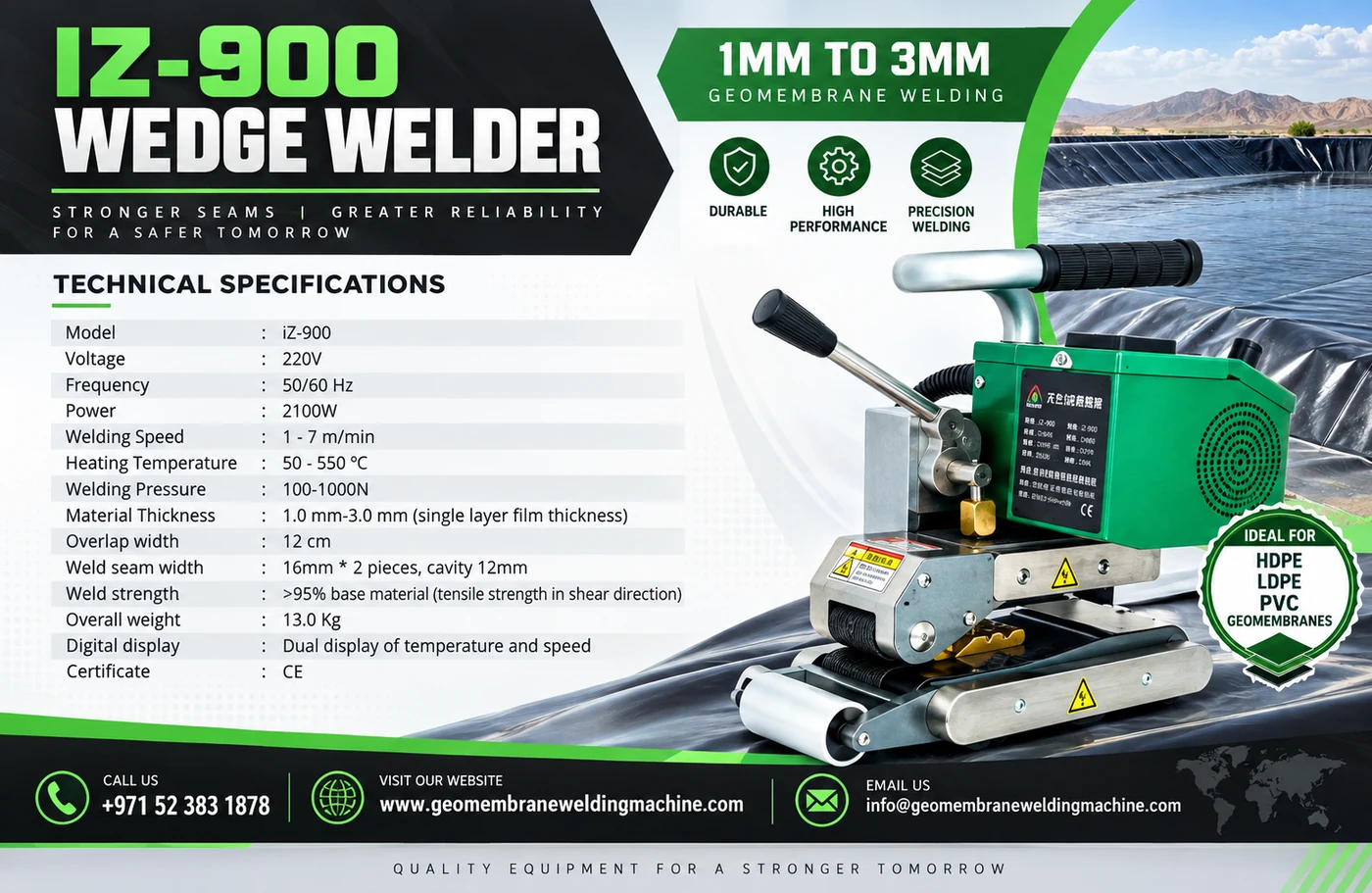
The IZ-900 starts at 1.0 mm
Its rated material range is 1.0 mm to 3.0 mm of single layer sheet. That covers irrigation reservoirs, canals, landfill, leach pads and tailings. It does not cover the 0.75 mm liner common on farm ponds, water pans and aquaculture. For that gauge, the Weldy WGW 300 is rated from 0.8 mm and is the machine we quote.
A weld that looks right can still fail
A cold seam produced by excessive speed or insufficient heat often looks flawless. It peels apart cleanly at the interface under test because the two sheets were pressed together without properly fusing. This is why field peel and shear testing exists and why no experienced installer judges a wedge weld by appearance alone.
What to compare when you are buying
Wedge welders from different manufacturers look broadly alike and the differences that matter are not obvious from a photograph.
- Temperature stability under load. A machine that holds its set point while welding thick sheet in wind is worth far more than one whose element lags. Lagging shows up as intermittent cold spots along a seam.
- Pressure adjustment. Being able to set and repeat roller pressure matters as much as temperature, particularly across a range of liner gauges.
- Wedge access for cleaning. Some designs let you swing the wedge out for brushing in seconds; others need tools and cooling time.
- Parts availability. A cheaper machine with a three week wait on a heating element is not cheaper. Ask where the wear parts are held before you buy.
- Voltage and site power. Machines drawing over 2 kW on a long extension lead from a small generator will brown out. Confirm the site supply.
Our machine selection guide works through the same decision across all three welding processes.
Frequently asked questions
What is a hot wedge welding machine?
A hot wedge welding machine is a self-propelled tool that fuses two overlapping sheets of thermoplastic liner using a heated metal wedge. The wedge slides between the two sheets and melts their facing surfaces; immediately behind it, a pair of driven rollers presses the molten faces together under set pressure. The machine pulls itself along the overlap as it works, so a single operator can produce hundreds of metres of consistent seam in a shift. Nothing is added to the joint, which is what distinguishes it from extrusion welding.
What is a dual track weld and why does it matter?
A dual track wedge produces two parallel welds with an unwelded gap between them. That gap is a sealed channel running the length of the seam. Inserting a needle at one end and pressurising the channel lets the whole seam be tested non-destructively in one operation: if pressure holds for the specified period, every metre of that seam is sound. A single track weld gives no such channel and has to be tested by vacuum box or destructively. Almost every geomembrane specification therefore requires dual track welding on primary seams, tested to ASTM D5820. The air test kit is a separate purchase.
What temperature should the wedge be set to?
There is no single correct figure, which is why machines have digital control rather than a fixed setting. Wedge temperature for HDPE typically sits between 330°C and 420°C, but the right value on any given day depends on sheet thickness, ambient temperature, wind, whether the liner is in direct sun, and the travel speed you intend to run. In Gulf summer conditions the sheet may already be at 60°C or more, so less heat input is needed than the same job would take in winter. Establish the setting with trial welds and peel test them before starting production seams.
How fast can a wedge welder run?
Machine capability is usually 0.5 to 5.0 m/min, but production speed is set by the material and the specification, not by the machine's maximum. Thin 0.75 mm liner in mild conditions can run at the upper end. Heavy 2.0 mm and 2.5 mm sheet for mining work runs far slower because the wedge has to deliver heat through much more material. Running faster than the sheet allows produces a cold weld that looks acceptable and fails peel testing, so speed is always confirmed by trial weld rather than assumed.
Can a wedge welding machine weld PVC and other materials?
Yes. The same machine welds HDPE, LLDPE, PVC, EVA and PP, along with coated fabrics and some geotextile composites, because all of them are thermoplastics that soften and fuse under heat and pressure. What changes between materials is the temperature and speed window, and PVC in particular runs much cooler than HDPE and scorches if treated like it. For thin PVC and tarpaulin work, a hot air welder is often the better tool.
What are the wear parts on a wedge welder?
The wedge itself, the drive and pressure rollers, the drive belt or chain, and the carbon brushes in the motor. Rollers wear or glaze with use and stop gripping properly, which shows up as inconsistent seam pressure. The wedge accumulates burnt polymer and needs cleaning with a brass brush while warm, never a steel one. Elements fail eventually. We keep wear parts in stock in Dubai so a failure does not stand a crew down waiting on an overseas order.
What is the HS code for a geomembrane welding machine?
Plastic welding machines of this type generally classify under HS heading 8477, which covers machinery for working rubber or plastics, with 8477.80 the usual subheading for welding equipment not specified elsewhere. Some customs authorities classify hand held hot air tools under 8515 instead. Because classification decisions rest with the authority in the destination country and carry duty consequences, we state the code we use on the commercial invoice and recommend confirming it with your clearing agent before shipment. See export documentation for what we provide.
It is one part of a broader offering in geomembrane welding machines and HDPE liner.
Related pages
- Extrusion welding machineThe hand welder that finishes every detail a wedge machine cannot reach.
- Seam testing equipmentAir pressure pumps and gauges to test the channel your wedge welder leaves behind.
- HDPE geomembrane sheetThe liner this machine welds, with the seam strength values it has to reach.
- Welding rod and fillerMatched HDPE rod for the extrusion repairs that follow wedge welding.
Get an IZ-900 quoted to your site
Tell us the liner thickness and where the machine is going. We will confirm the right model, the voltage configuration and a delivered price.