HDPE pond liner
Impermeable HDPE liner for farm ponds, irrigation reservoirs, water pans, aquaculture and landscape lakes. Supplied from Dubai with the welding equipment to install it and mill certificates against every roll.
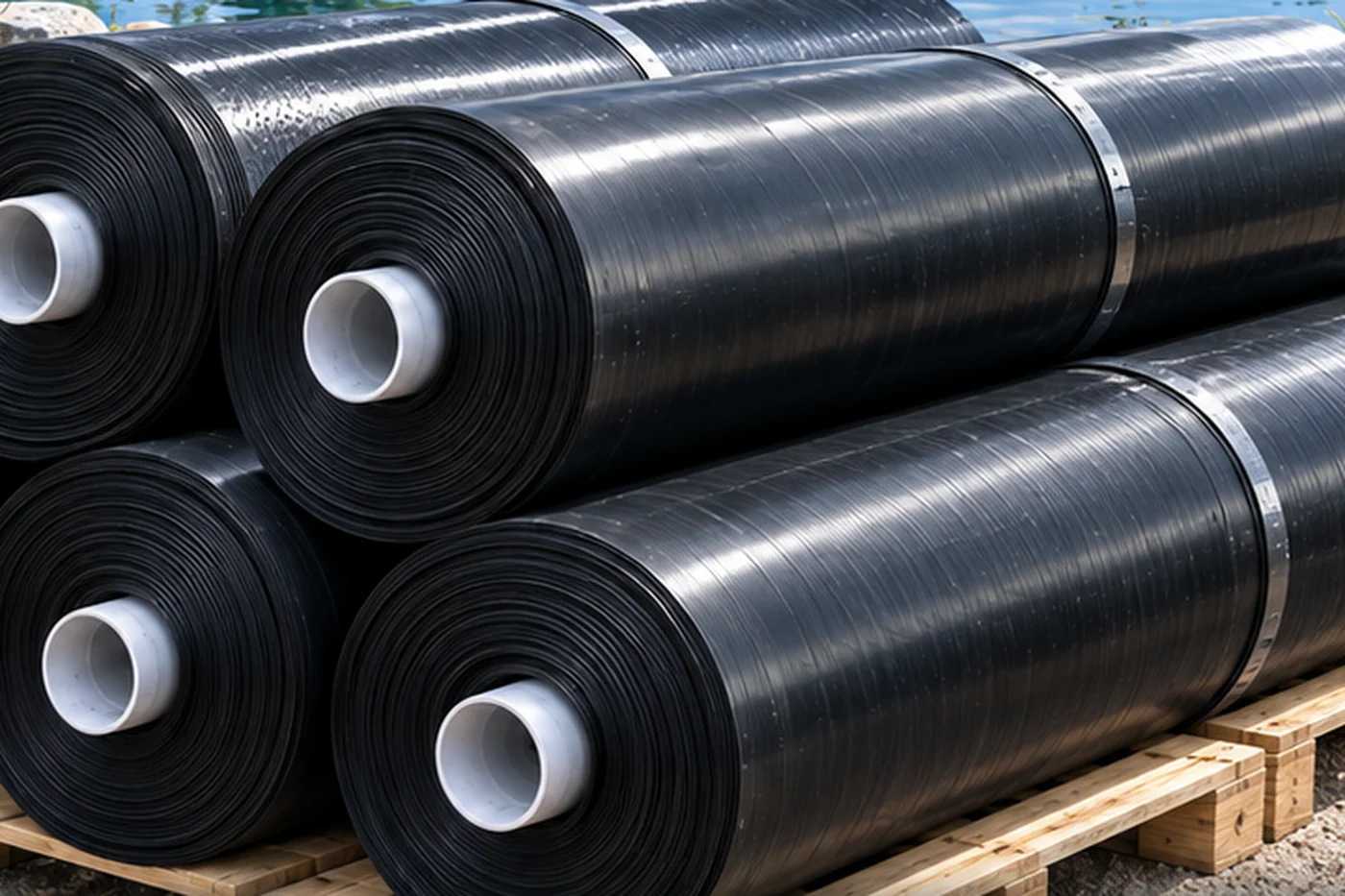
An unlined pond in this region loses water two ways at once. It seeps into the ground, and it evaporates from the surface. Across the Gulf and much of East Africa the seepage loss alone makes unlined storage impractical, which is why almost every farm reservoir, water pan and irrigation basin built in the last two decades has an HDPE liner in it.
What a lined pond involves
The subgrade is prepared first: shaped to the design profile, compacted, and picked over for stones and roots that could puncture the sheet from below. Where the ground is rough, a cushion geotextile goes down.
Liner panels are then deployed and positioned. On batters, panels run down the slope rather than across it, so that seams are not loaded in shear by any material moving down the face. Panels are tacked with a hot air gun so wind cannot shift them before the real seam is made.
The wedge welder then makes the production seams, and a hand extruder details the inlet, the outlet, any pipe penetrations and the corners. Seams are tested, and the liner is anchored into a trench at the crest and backfilled.
Choosing a thickness
Thicker is not automatically better. Heavier sheet resists puncture more but is harder to handle in wind, slower to weld, and more expensive per square metre, so oversizing has real cost. The decision is driven by subgrade quality, water depth, whether machinery will work near the liner, and how long the asset has to last.
Specification
Pond liner is the same HDPE geomembrane described in our specification, selected for water storage duty. Thickness is the only real decision.
| Parameter | Typical range |
|---|---|
| Material | High-density polyethylene, virgin resin |
| Thickness range | 0.75 mm to 3.00 mm |
| Most common for ponds | 0.75 mm and 1.00 mm |
| Minimum average density | 0.940 g/cc |
| Carbon black content | 2.0 to 3.0 percent |
| Roll width | 7 m |
| Surface | Smooth, or textured for steeper batters |
| Jointing | Hot wedge welded, extrusion welded at detail |
| Certification | Mill certificates against roll numbers |
| Underlay | Cushion geotextile recommended on rough subgrade |
Thickness is a design decision driven by water depth, subgrade condition, loading and expected service life. Where a design engineer has specified a gauge, use it rather than the general guidance above.
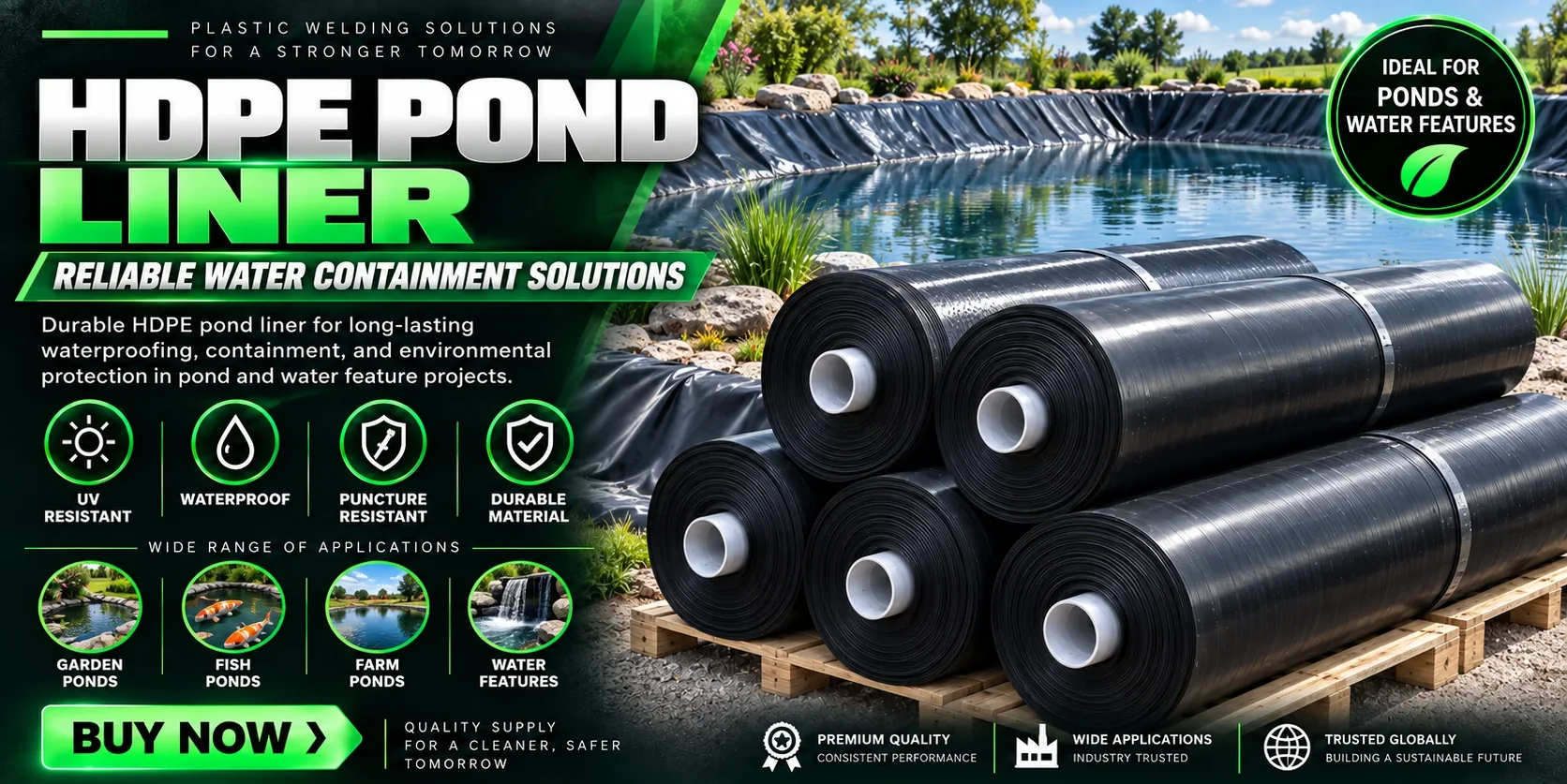
Pond liner product sheet
Downloadable and shareable. Right click to save, or send it from WhatsApp when a customer asks what the liner covers.
Thickness by pond type
| Application | Common thickness | Why |
|---|---|---|
| Seasonal farm pond, water pan | 0.75 mm | Shallow, prepared subgrade, light duty |
| Irrigation reservoir | 1.00 mm | Deeper water, longer service expectation |
| Aquaculture pond | 0.75 to 1.00 mm | Water quality control as much as seepage |
| Landscape lake, water feature | 1.00 mm | Prepared subgrade, permanent installation |
| Effluent or process lagoon | 1.50 mm | Chemical duty and regulatory expectation |
| Rough subgrade or heavy plant access | 1.50 mm and above | Puncture risk dominates the decision |
Use the pond liner calculator to turn your dimensions into an area and roll count at the gauge you choose.
Budget for the seams, not just the sheet
A pond quotation built on liner cost alone is incomplete. Every panel joint has to be welded and tested, which means welding plant, rod, test equipment and crew time. On a small pond the equipment can exceed the material cost, which is why contractors buy machines once and use them across many jobs.
Frequently asked questions
What thickness should a pond liner be?
For farm ponds, water pans and aquaculture, 0.75 mm and 1.00 mm cover the great majority of work. Move to 1.50 mm where the subgrade is rough, where machinery will work near the liner, where the water is deep, or where the pond is a long term asset rather than seasonal storage. Decorative lakes and landscape water features are usually 1.00 mm because the subgrade is prepared and loading is light. Full properties per grade are in the specification table.
How much liner does my pond need?
More than the water surface area. The sheet covers the floor, climbs every batter, and runs into an anchor trench at the top, and a sloped face is longer than the depth because it is a hypotenuse. Our pond liner calculator does the arithmetic from your top dimensions, depth and batter slope, and returns area, roll count and seam length.
Does a pond liner need a geotextile underneath?
Wherever the subgrade is anything other than smooth, fine and stone free, yes. A cushion geotextile sits between the ground and the liner and absorbs the point loading from stones and angular material that would otherwise puncture the sheet, particularly once water depth presses the liner down onto it. On a properly prepared, rolled and picked subgrade it can sometimes be omitted, but the geotextile is far cheaper than draining a pond to find a puncture.
Can I install a pond liner without welding equipment?
Only for a pond small enough to be covered by a single panel with no joints, which in practice means under about 7 m in one direction because that is the roll width. Beyond that there are seams, and seams in HDPE have to be welded. There is no adhesive or tape that gives a durable watertight joint in polyethylene. That means a wedge welder for the panel seams and a hand extruder for the inlet and outlet detail.
How long will an HDPE pond liner last?
Covered or submerged liner protected from sunlight lasts decades. Exposed liner on the batters above waterline ages considerably faster, because ultraviolet light and heat deplete the antioxidant package in the polymer, and in Gulf conditions that exposure is severe. Where the design allows, covering the exposed batters with soil, gravel or concrete matting is the single largest thing you can do to extend service life.
Is HDPE better than PVC or EPDM for a pond?
For anything of scale, yes. HDPE has far better chemical resistance and a longer service life, and it is what specifications call for in agricultural, industrial and municipal work. PVC and EPDM are more flexible and easier to fit around complex shapes without welding equipment, which makes them common in small garden ponds. The trade-off is a shorter life, particularly under strong sunlight. For anything from a farm reservoir upward, HDPE is the correct material.
This is part of a single supply chain covering machines, consumables and geomembrane.
Related pages
- Pond liner calculatorArea, waste allowance, roll count and seam length from your basin dimensions.
- Wedge welding machineThe machine that makes the panel seams a pond liner depends on.
- Technical specificationsFull ASTM property table for every gauge, including seam strength values.
- Root barrier membraneFor landscape work on the same site, where roots rather than water are the problem.
Quote a pond lining package
Send the pond dimensions and depth. We will take off the liner quantity and quote sheet, welding machines and consumables together.