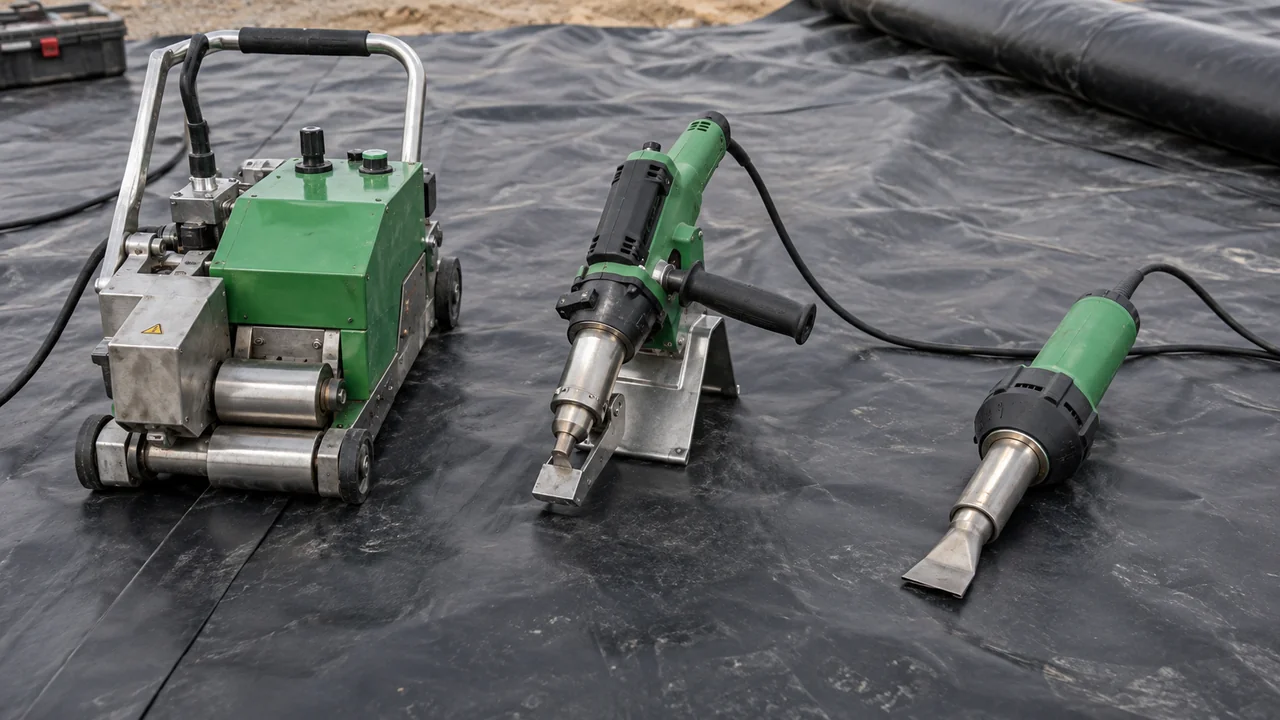
Start with the specification, not the catalogue
Almost every geomembrane project has a document that names the welding process. It will say something close to: primary seams shall be made by dual track hot wedge fusion welding and tested by air pressure in accordance with ASTM D5820, and extrusion welding shall be permitted only for patches, penetrations and repairs, tested by vacuum box to ASTM D5641.
If your project has a clause like that, the machine question is already answered. You need a dual track wedge welder and you need a hand extruder, because neither one can do the other's job. Buying only the wedge welder is the most common and most expensive mistake in this trade: the crew reaches the first pipe penetration and stops.
The three processes and what each is for
Hot wedge welding makes the long production seams. A heated wedge melts the facing surfaces of an overlap and driven rollers press them together while the machine propels itself along. It is fast, consistent, and it produces a dual track weld with a sealed channel that can be air tested along its entire length. This is why specifications require it.
Extrusion welding adds molten HDPE from a rod to build a fillet bead. It is slower and depends on operator skill, but it works on patches, corners, pipe boots and anywhere a wheeled machine cannot travel.
Hot air welding tacks liner panels in position before the wedge welder passes, preheats for extrusion work, and welds thin materials such as PVC and tarpaulin outright. It is the cheapest machine on the list and the one used most often.
What to compare between machines
Wedge welders from different manufacturers look broadly identical in a photograph. The differences that matter are not visible.
- Temperature stability under load. A machine that holds its set point while welding 2 mm sheet in wind is worth far more than one whose element lags behind. Lagging produces intermittent cold sections that pass visual inspection and fail peel testing.
- Repeatable pressure adjustment. Roller pressure matters as much as temperature, and being able to set it to a number and return to it is what makes results reproducible across gauges.
- Parts availability. A cheaper machine with a three week wait on a heating element is not cheaper. Carbon brushes alone last about 1,600 hours, so ask where wear parts are held before you buy.
- Power draw against site supply. A 2 kW machine on an undersized generator at the end of a long extension will brown out, and the symptom is bad seams rather than an obvious fault.
- Extruder output rate. Bigger is not better. A 5 kg/h machine is heavy and clumsy for patch work; 2 to 3 kg/h suits most lining crews.
Match the machine to the liner gauge
Thickness drives everything, and it decides which wedge welder you can even consider. Our IZ-900 is rated from 1.0 mm; the Weldy WGW 300 from 0.8 mm. If 0.75 mm farm pond liner is in your work, that single line settles it. Thin 0.75 mm liner for farm ponds welds fast and forgives a lot. Heavy 2.5 mm mining sheet needs sustained heat delivered slowly, and a machine at the bottom of its capability will struggle. Check the stated thickness range against what you actually weld most, not against the heaviest job you hope to win.
Budget for the things that are not the machine
An equipment budget built only around welders is short by a meaningful margin. Work out the real machine hours first with the seam length calculator, because that decides whether one welder covers your programme. You also need welding rod in the grade matching your liner, the test equipment the specification demands, and a spares kit. Without the test kit you cannot hand the work over, whatever the seams are like.
Own brand or Weldy?
We carry both, and the honest split is this. If a specification names a European brand, or the crew wants a Leister group name on the machine, the Weldy range satisfies it. If price decides and the liner is 1.0 mm or heavier, the IZ range does the same work for less. The one case where the choice is made for you is thin liner: only the WGW 300 welds 0.8 mm.
The order that actually works
Wedge welder, hand extruder, hot air gun, rod, air test kit, vacuum box, spare heating elements and carbon brushes. That equips a crew to start and finish a project without stopping. Anything less and the gap shows up on site rather than in the quotation.
Frequently asked questions
Can one machine do all geomembrane welding?
No. The geometry rules it out. A wedge welder has to roll in a straight line along an overlap, so it physically cannot weld around a pipe penetration, into a corner or over a patch. An extruder can reach anywhere but cannot produce the dual track air testable seam specifications require for production welding. Any crew equipped to complete a project carries both, plus a hot air gun for tacking.
Should I buy new or used?
Used machines can be sound, but the parts that determine seam quality are the parts that wear invisibly. A machine with a tired heating element holds temperature at idle and drops under load, and you will not discover that until you peel test. If you do buy used, test weld before purchase and pull coupons, and budget immediately for a new element and roller set.
This connects to the rest of what we do as a supplier and dealer of plastic welding equipment.