Where small genuinely wins
Repair and maintenance work. A crew whose job is fixing existing liner rather than installing new is doing patches, penetrations and short seams almost exclusively. A 1.5 kg/h extruder and a hot air gun cover that entirely, and both fit in a vehicle.
Detail and confined positions. A light extruder can be held at an angle, worked overhead and manoeuvred around a pipe boot for a full shift. A 5 kg/h machine cannot be held that way for more than a few minutes, and operator fatigue shows up directly in bead quality.
Remote and access constrained sites. Where equipment is carried in by hand or moved between many small locations, weight is a real constraint rather than a specification line.
Small ponds and tank work. Jobs where total seam length is measured in tens of metres rather than hundreds, and where a full size wedge welder would spend most of its time being carried.
Where small is a false economy
Production seaming. There is no compact substitute for a proper dual track wedge welder on a lined structure of any size. Undersized machines struggle to hold temperature on thicker sheet, and the specification will still demand an air testable dual track seam.
Thick liner. A small extruder running at the top of its output on 2.00 mm sheet all day will overheat, wear quickly and deliver an inconsistent bead. Match the machine to the heaviest gauge you regularly weld, not the lightest.
Continuous fillet welding. Tank and duct fabrication needs deposition rate. A small machine turns a day's work into three.
What to check before buying compact kit
- Duty cycle, not just output. A machine rated for intermittent use will not survive being run continuously, and this is where cheap compact machines fail first.
- Temperature control quality. Compact does not have to mean crude. Electronic control that holds a set point under load matters as much on a small machine as a large one.
- Parts availability. Small machines are often the ones with the worst parts support, because they are sold as accessories rather than as plant. Check that elements, shoes and nozzles can be obtained.
- Rod diameter compatibility. Most compact extruders take 3 mm rod and will not run 4 mm. Check it against your existing rod stock before ordering.
- Actual weight in use. Published weight often excludes the cable and the rod. Both matter when the machine is held at arm's length.
The sensible compromise for most crews
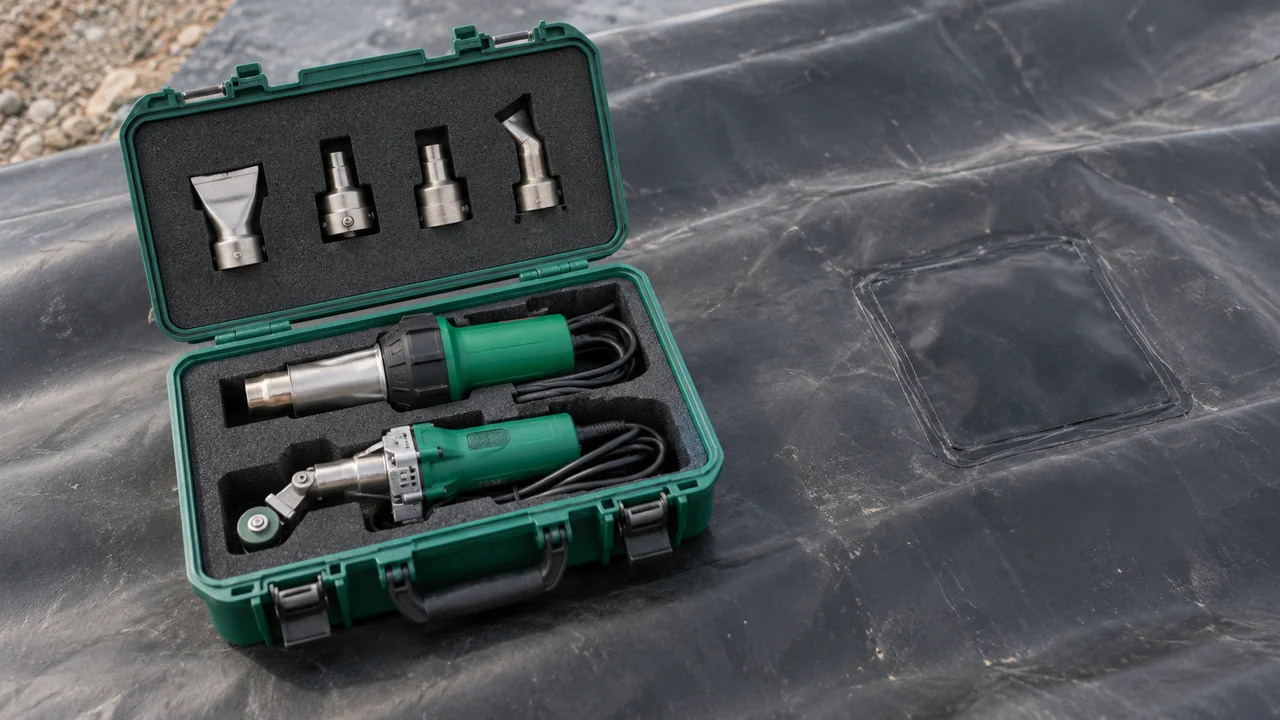
A mid range extruder around 2 to 3 kg/h, a good hot air gun with a nozzle set such as the Weldy HT1600 in its overlap kit, and a full size wedge welder. That combination handles production seams properly and stays workable on detail. Buying the smallest of everything saves money once and costs it on every large job afterwards.
Frequently asked questions
Is a small extrusion welder good enough for geomembrane repair?
For repair work specifically, yes, and often better than a large one. Patches, penetrations and short seams need control rather than deposition rate, and a light machine is easier to hold accurately for a full shift. What a small extruder cannot do is replace a wedge welder on production seams, because no extruder produces an air testable dual track weld.
What is the lightest kit that can complete a small lining job?
If the structure is genuinely small, a hot air gun, a compact extruder, rod and a vacuum box will get a pond in. The moment the job has panel to panel seams that a specification will be tested against, a wedge welder and air test kit become unavoidable, because the acceptance criteria demand a seam type only that machine produces.
All of this is backed by the machine range we stock and export from Dubai.