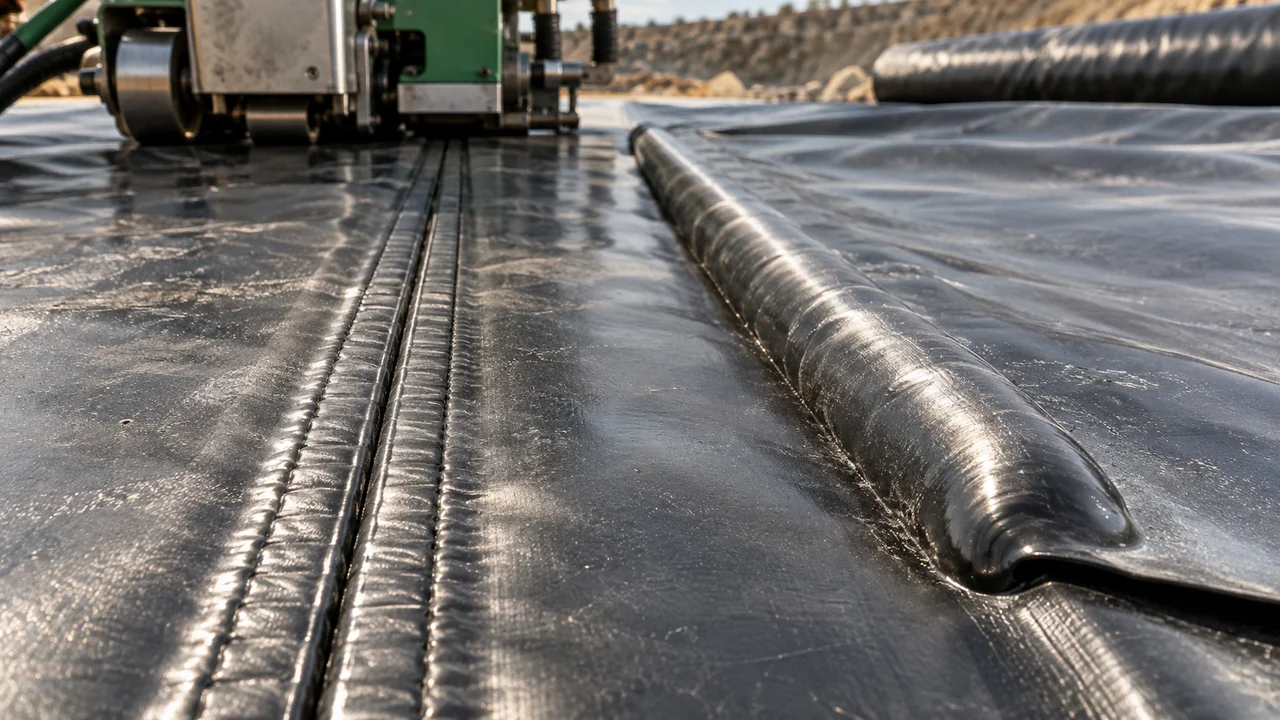
How each one joins the sheet
Wedge welding adds nothing. A heated metal wedge slides into the overlap between two sheets and melts their facing surfaces. Immediately behind it, two driven rollers squeeze the softened faces together under set pressure. The material of the seam is the material of the sheets, fused into one.
Extrusion welding adds new polymer. A screw in a heated barrel melts solid welding rod and extrudes it through a shoe onto the joint, while hot air softens the parent sheet just ahead so the two fuse. The seam is a bead of new material bonded across the sheet edge.
The difference that drives everything else
A dual track wedge produces two parallel welds with an unwelded channel between them. Seal both ends, insert a needle, pressurise, and the gauge tells you whether the whole seam holds. That is a non-destructive test of every metre, done in minutes, producing a number for the quality record.
An extrusion bead has no channel and never can. It is proven by placing a vacuum box over a soaped section and looking for bubbles, one box length at a time. It works, but it is slow and positional.
This single fact explains why specifications require wedge welding on all primary seams and restrict extrusion to places where wedge welding is impossible. It is not a judgement about weld strength. It is about what can be proven.
Side by side
| Property | Hot wedge | Extrusion |
|---|---|---|
| Filler added | None | HDPE or LLDPE rod |
| Seam form | Dual track with test channel | Fillet bead over sheet edge |
| Speed | 0.5 to 5 m/min, self-propelled | Walking pace, operator controlled |
| Non-destructive test | Air pressure, ASTM D5820 | Vacuum box, ASTM D5641 |
| Consistency | Machine held, highly repeatable | Operator dependent |
| Required peel strength, 1.5 mm | 15.9 kN/m | 13.6 kN/m |
| Used for | Production seams, panel to panel | Patches, penetrations, corners, repairs |
| Surface preparation | Clean and dry overlap | Ground back and welded same day |
Required peel values differ by gauge. The full set is in the liner specification.
Why the extrusion peel requirement is lower
People sometimes read the lower extrusion figure as evidence the process is weaker. It is not. The two joints have different geometry, so peel loads them differently, and the acceptance values reflect that. A properly made extrusion bead fails in the parent sheet just as a wedge seam does.
What each process demands from the operator
A wedge welder rewards setup. Get the temperature, speed and pressure right on a trial weld and the machine will reproduce that seam for hundreds of metres. The skill sits in establishing the settings and in watching alignment.
An extruder rewards technique, continuously. Preheat has to actually soften the sheet, travel speed has to match the output rate, and the surface has to be prepared properly. Get any of that wrong and the bead lifts under test. This is why crews put their most experienced person on detail work.
Frequently asked questions
Can I use extrusion welding for all my seams?
Technically it will hold, but almost no specification allows it and no engineer will accept it. Extrusion seams cannot be air pressure tested, so proving hundreds of metres would mean vacuum boxing every metre, which is impractically slow, or cutting destructive coupons at close intervals, which damages the liner. Production seams go to a wedge welder.
Which process is stronger?
Both should be stronger than the sheet, which is the actual acceptance criterion. In a correctly made seam of either type, a peel coupon fails in the parent material away from the weld rather than at the weld interface. Failure mode matters more than the recorded load, because a seam that separates at the interface has failed even if the number looked acceptable.
Everything here is part of the welding equipment we stock in Dubai for export.