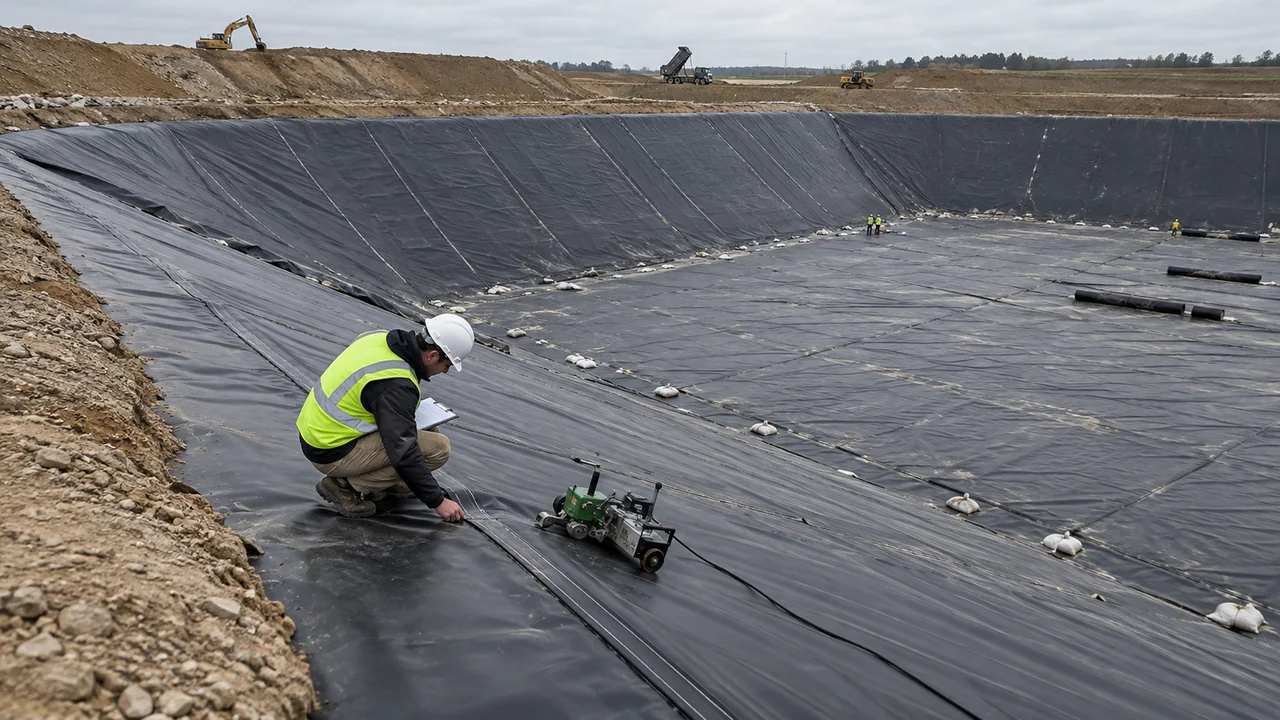
Why landfill is different
Most lined structures can be drained and inspected. A landfill base liner is covered by a drainage layer and then by waste, permanently. Nobody is going back to look at it. Everything anyone will ever know about that liner has to be established and recorded before the first load tips.
Base liners are typically 1.50 mm or heavier, and capping systems often specify textured sheet on the side slopes for interface friction. That is why construction quality assurance exists as a formal discipline on these projects, usually carried out by a consultant independent of the installer, working to a written CQA plan that forms part of the contract.
Trial welds
Before any production welding, and generally at the start of each shift, after any significant change in conditions, and whenever a machine is restarted, the operator makes a trial weld on offcuts of the project liner using the machine and settings intended for production.
Coupons are cut from that trial and pulled in a field tensiometer for peel and shear. Both the load and the failure mode are recorded. Only when the trial passes may that machine, that operator and those settings be used on the works. A failed trial means re-setting and repeating, not proceeding carefully.
Non-destructive testing of every seam
One hundred percent of production seams are tested. Dual track wedge seams are air pressure tested through their channel to ASTM D5820, and the end is cut afterwards to prove the channel was open and the test valid. Extrusion welds, patches, cap strips and penetrations are vacuum box tested to ASTM D5641.
Each test is recorded against a seam number that appears on the as-built panel layout drawing, so any seam can be traced back to its operator, machine, date, settings and test result years later.
Destructive sampling
Samples are cut from production seams at a frequency set by the CQA plan, commonly one per fixed length of seam. Part goes to the laboratory, part is tested on site, and part is retained. Each is pulled for peel and shear against the values in the specification, and the failure mode is recorded alongside the load. Required values by gauge are in the liner specification.
Every sample leaves a hole in the liner, which is patched and vacuum box tested like any other repair. That is one reason destructive frequency is negotiated rather than maximised: each test creates a defect that has to be made good.
When a sample fails, the specification normally requires tracking in both directions along the seam, taking further samples until passing results bracket the failure, and reworking everything between them by cap strip. On a bad day that can be a substantial length of seam.
What has to be on site
- A dual track wedge welder, and realistically a spare, because a machine failure stops a CQA project entirely.
- A hand extruder with matched rod.
- Air pressure test equipment and a vacuum box, from the testing range.
- A field tensiometer and a coupon cutter, for trial and production samples.
- Spare heating elements and wear parts, because a two week wait on a part is a two week delay to the programme.
The paperwork is the deliverable
On a landfill project the physical liner and the CQA record are equally part of what you hand over. A perfectly welded cell with incomplete documentation will not be accepted, because acceptance rests on evidence rather than on the seam itself. Contractors who lose money on these projects usually lose it on rework and documentation, not on material.
Frequently asked questions
What is CQA on a geomembrane project?
Construction quality assurance: a formal, documented regime, normally carried out by a consultant independent of the installer, that verifies the liner was installed to specification. It covers material conformance, subgrade acceptance, panel placement, trial welds, non-destructive testing of every seam, destructive sampling at set frequency, and the as-built record tying all of it together.
How often are destructive samples taken?
The CQA plan sets it, and it is commonly expressed as one sample per fixed length of seam. The exact figure varies by project and jurisdiction, so work to the number in your own documents rather than a general rule. Some plans allow the frequency to be reduced once a run of passing results is established, which is worth asking about because every sample creates a hole that must be patched and retested.
What happens if a landfill seam fails testing?
For a failed air test, the seam is subdivided and retested to locate the leak, then the defective length is cap stripped with extrusion welding and vacuum box tested. For a failed destructive sample, the usual requirement is to track along the seam in both directions taking further samples until passing results bracket the failure, and rework everything in between. All of it is recorded.
See how this fits the rest of our geomembrane welding machine supply.