Two families of test
Non-destructive tests check seams without damaging them, and cover the entire production length. Destructive tests cut coupons out and pull them, giving actual strength numbers at intervals. A proper quality regime uses both, because each catches what the other misses.
Air pressure testing, ASTM D5820
Applies to the dual track seams a wedge welder produces, which carry an unwelded channel running between their two weld tracks. Both ends are sealed, a needle is inserted, and the channel is brought up to the pressure the specification requires, commonly around 200 kPa. Pressure is allowed to stabilise, then held for a set period, usually five minutes, and the drop is recorded.
The step people skip is cutting the far end afterwards to confirm the channel was actually open. A blocked channel holds pressure beautifully and proves nothing. If air does not escape when you cut it, the test was invalid.
Vacuum box testing, ASTM D5641
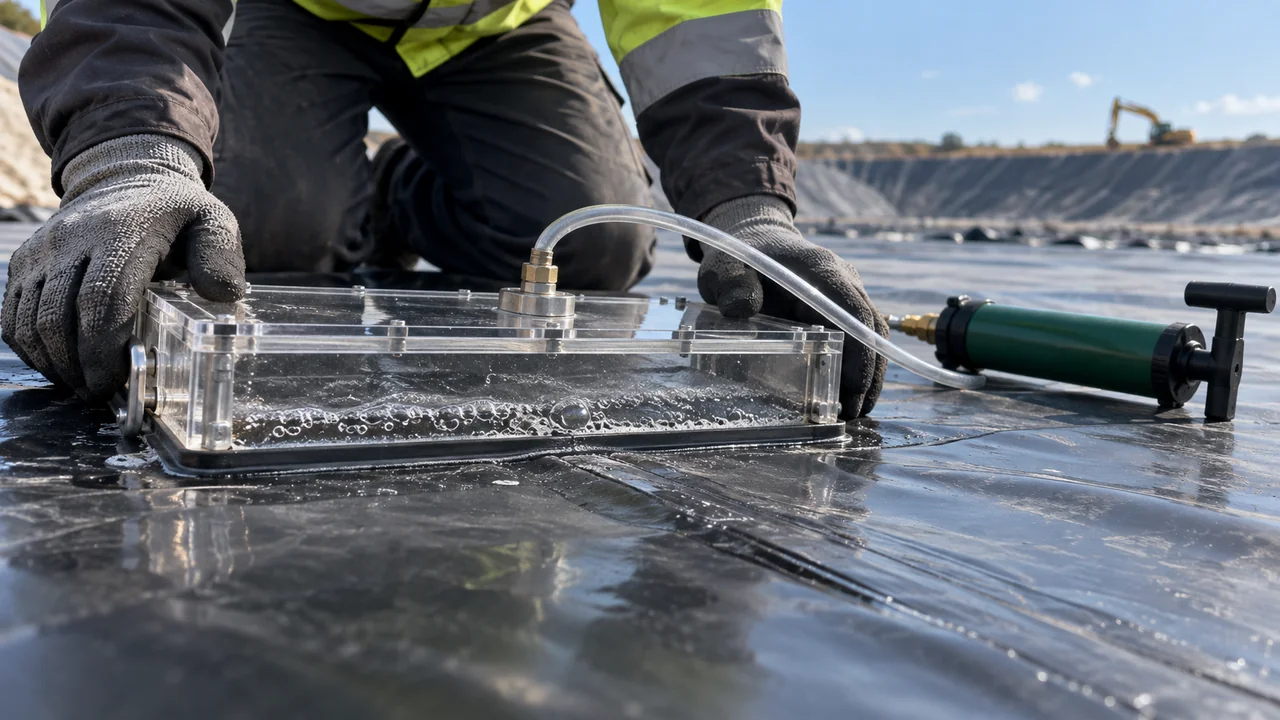
Applies to everything without a channel: extrusion welds, patches, cap strips, pipe boot welds and repairs. The seam is wetted with soap solution, a box with a transparent top and a foam gasket is placed over it, and a pump draws the box below atmospheric pressure. Leaks pull air through the soap film and produce visible bubbles.
It is reliable but slow and positional, testing only the length of the box at a time, and it needs a reasonably flat surface for the gasket to seal against. Both limitations are why specifications prefer wedge welding wherever the geometry allows.
Peel and shear, ASTM D6392
Coupons are cut from production seams at intervals set by the CQA plan and pulled in a field tensiometer. A shear test loads the seam in the plane of the sheet. A peel test pulls the two sheets apart at the weld.
Both record a load, and both record something more important: where the sample broke. A sound seam fails in the parent sheet away from the weld, because the weld is stronger than the material around it. A seam that separates at the interface has failed, whatever the number, because it shows the sheets were pressed together rather than fused. Required values by gauge are in the liner specification.
Which test for which seam
| Seam or feature | Method | Standard |
|---|---|---|
| Dual track wedge production seam | Air pressure | ASTM D5820 |
| Extrusion fillet weld | Vacuum box | ASTM D5641 |
| Patch or repair | Vacuum box | ASTM D5641 |
| Pipe penetration boot | Vacuum box, sometimes spark | ASTM D5641 |
| Trial and production coupons | Peel and shear | ASTM D6392 |
Testing in high ambient temperature
Air expands as the liner heats through the day. A channel pressurised early and read in full sun can show a rise rather than a drop, and a seam tested into falling temperature can show a drop that is thermal rather than a leak. Allow the channel to stabilise before starting the hold period, and record ambient conditions alongside the reading so it can be interpreted properly later.
Frequently asked questions
What pressure is a geomembrane seam tested to?
It is set by the project specification and varies with liner thickness, but figures around 190 to 210 kPa are typical, held for five minutes with a maximum permitted drop. Thicker liner generally tests at higher pressure. Always work to the number in your CQA plan rather than a general figure, because acceptance is judged against that document.
What happens if a seam fails its test?
For a failed air test, the run is isolated by testing shorter sections to locate the leak, then the defective length is cap stripped and extrusion welded, and the repair is vacuum box tested. For a failed coupon, the specification normally requires tracking back along the seam in both directions, testing further coupons until passing results bracket the failure, and reworking everything between them.
It works together with the rest of our welding machine and liner supply from Dubai.