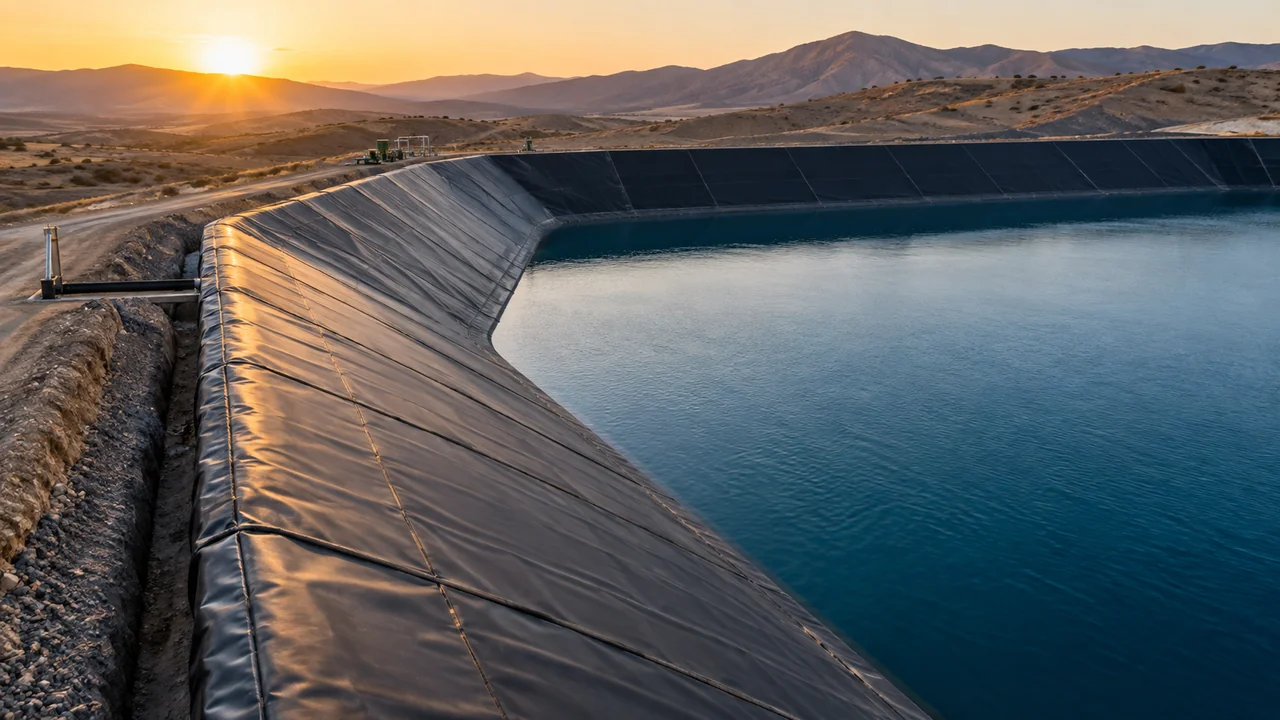
What it is
A geomembrane is a continuous sheet of low permeability synthetic material, used as a barrier in soil and rock. In practice that almost always means high density polyethylene, produced in rolls, delivered to site and welded panel to panel into one continuous membrane. Linear low density polyethylene, PVC and a few specialist materials cover the remainder.
HDPE dominates because it combines very low permeability with broad chemical resistance, strength and a service life measured in decades. Its properties are set out in the technical specification.
Where it is used
Landfill. Base liners stop leachate reaching groundwater, capping systems stop rainwater entering the waste mass. These projects carry the strictest seam requirements of any application.
Water storage. Reservoirs, farm ponds, water pans and potable storage, particularly across the Gulf and East Africa, where seepage and evaporation losses make unlined storage impractical.
Canal and channel lining. Irrigation networks lose enormous volumes to seepage. Lining converts that loss into delivered water.
Mining. Heap leach pads, tailings storage facilities and process ponds, where the liner contains aggressive chemistry under heavy loading. Thick sheet and full quality assurance are the norm.
Industrial containment. Tank farm bunds, secondary containment, effluent lagoons and remediation cells.
Aquaculture. Fish and shrimp ponds, where the liner improves water quality control as much as it prevents seepage.
Decorative and landscape water. Lakes and water features, a particularly common application in Gulf development. On the same sites, root barrier membrane protects paving and services from the planting around them.
Why the seam is the whole issue
The sheet arrives tested and certified. Its permeability, strength and durability are known before it leaves the factory, and a mill certificate documents them. None of that is in question on site.
What happens on site is that panels get joined, in heat, dust and wind, by a crew working to a programme. Every joint is a potential leak path, and a liner with a failed seam performs no better than no liner at all along that line. This is why specifications devote more text to welding and testing than to the material itself, and why the equipment that makes those seams matters as much as the sheet.
Thickness by application
| Application | Common thickness |
|---|---|
| Farm ponds, water pans, aquaculture | 0.75 mm to 1.00 mm |
| Irrigation reservoirs, effluent lagoons | 1.00 mm to 1.50 mm |
| Canal lining | 1.00 mm to 1.50 mm |
| Landfill base and capping | 1.50 mm to 2.00 mm |
| Leach pads and tailings | 1.50 mm to 2.50 mm |
| Severe duty containment | 2.50 mm to 3.00 mm |
Thickness is set by the design engineer against hydraulic head, subgrade, loading and chemical exposure. These are orientation figures, not a substitute for a design.
What goes with the liner
A lined structure is rarely liner alone. A cushion geotextile commonly sits beneath it to protect against subgrade puncture. Drainage layers may sit above. On slopes, textured sheet provides the interface friction that keeps cover material in place. Anchor trenches secure the perimeter, and pipe penetrations are detailed with fabricated boots.
Frequently asked questions
Is a geomembrane completely waterproof?
The sheet itself is effectively impermeable for engineering purposes, with permeability orders of magnitude below compacted clay. Whether the installed system is watertight depends on the seams and on damage during installation, which is why welding is tested along its entire length and why installers work under construction quality assurance. A correctly installed and tested liner performs as designed. A poorly seamed one leaks at the joints regardless of the sheet's properties.
How long does a geomembrane liner last?
Buried or covered liner protected from ultraviolet light is routinely designed on a service life beyond fifty years, and many installations have exceeded that. Permanently exposed liner in a hot climate ages considerably faster because UV and heat deplete the antioxidant package protecting the polymer. Covering exposed liner where the design allows is the single largest factor in extending service life.
The complete range, machines and material both, is set out on our home page.